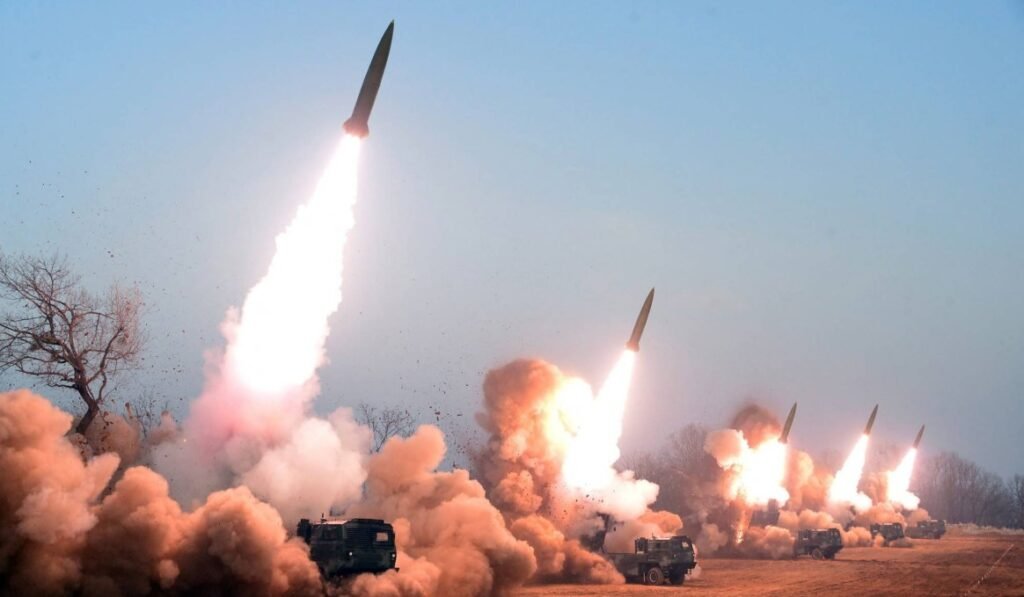
North Korea fired around 10 short-range ballistic missiles toward the sea off its east coast on Thursday, October 29, according to South Korea’s military, prompting renewed security concerns in the region.
The missiles were launched from an area near Wonsan on North Korea’s eastern coast at approximately 12:30 p.m. local time, South Korea’s Joint Chiefs of Staff said. They travelled about 250 kilometres, according to Yonhap News Agency
South Korea and Japan Monitor the Launches
South Korea said its military was strengthening surveillance and maintaining readiness against the possibility of further launches. It was also sharing information with the United States and Japan.
Japan’s authorities separately reported detecting a possible ballistic missile launch. Japanese officials said the projectile did not appear to have landed within the country’s exclusive economic zone, the maritime area in which a country has specific rights over resources.
Japan’s Chief Cabinet Secretary Minoru Kihara said the launches “violate U.N. Security Council resolutions and pose a serious problem to the safety of the people,” according to Qazinform Japan lodged a protest with North Korea through its embassy route in Beijing.
South Korea condemned the launches as violations of United Nations Security Council resolutions restricting North Korea’s ballistic missile activities.

A Wider Pattern of Military Tension
The latest launches come amid strained relations between the two Koreas and wider concerns about North Korea’s weapons programme.
South Korea’s military said the launches were North Korea’s third missile launch this month and its 17th ballistic missile firing this year, according to Yonhap. Pyongyang last test-fired missiles on October 12, claiming they were tactical ballistic missiles aimed at improving a key weapons component.
Tensions have also risen following a mine explosion in the Demilitarized Zone in September that injured three South Korean soldiers. Seoul has blamed North Korea, while Pyongyang has denied responsibility.
The launches came about a week after Seoul proposed holding military talks with Pyongyang to resolve border tensions. North Korea did not respond to the offer before firing the missiles, Yonhap reported.
The two countries remain technically at war because the 1950-1953 Korean War ended with an armistice rather than a peace treaty. Military activity along their heavily fortified border has therefore remained a recurring source of concern.
What Happens Next?
South Korea’s immediate response has focused on monitoring for further launches and coordinating with its allies. The latest incident adds to the challenge of maintaining stability on the Korean Peninsula while diplomatic and military tensions persist.
The launches do not, by themselves, establish that a wider conflict is imminent. However, repeated weapons tests can heighten regional uncertainty and increase the risk of miscalculation between opposing forces.