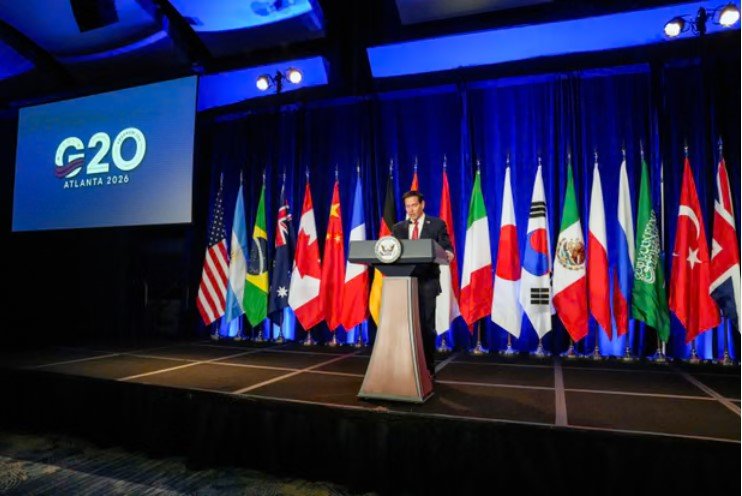
The United States has cancelled the traditional group photograph at the G20 foreign ministers’ meeting in Atlanta after several participating countries refused to appear alongside Russian Foreign Minister Sergey Lavrov.
The decision followed objections from European representatives, the United Kingdom and Australia, among others, who opposed sharing the photograph with Russia while its war against Ukraine continues.
US Secretary of State Marco Rubio removed the photograph from the meeting’s official programme after concerns that the disagreement would overshadow the diplomatic gathering.
According to The Guardian’s report, about one-third of the participating countries indicated they would not appear alongside Russian representatives.

Countries Reject Joint Appearance with Moscow
The disagreement centred on the presence of Lavrov, who represented Russia at the meeting.
German Foreign Minister Johann Wadephul said there could be no normal diplomatic appearance alongside Lavrov while Russia continued its invasion of Ukraine. British Foreign Secretary Ed Miliband also indicated that the UK would not participate in a photograph with the Russian representative.
Australia’s Foreign Minister Penny Wong publicly criticised Russia’s invasion during the meeting, describing it as illegal and warning about its wider effects on international markets and food security.
A spokesperson for Wong subsequently said Australia supported the US decision to cancel the photograph.
Reuters reported that European representatives had earlier considered the possibility of separate photographs, one including Lavrov and another without him. The US ultimately abandoned the traditional photo opportunity altogether.
Wider Disagreements Affect G20 Discussions
The disagreement over Russia reflects broader divisions within the group over the war in Ukraine and the Trump administration’s approach to Moscow.
The meeting also exposed tensions over the proposed membership of Poland, which attended as a guest and is seeking to join the G20. Russia opposed Poland’s proposed membership.
Another source of disagreement was the United States’ decision not to invite South Africa, the only African country in the G20, to the gathering.
South African officials said the country’s absence was not voluntary, while other participating countries reportedly objected to its exclusion.
Ukraine was also not invited, with US officials explaining that the country was not a formal member of the G20.
No Agreement Expected on Major International Issues
Despite Rubio’s appeal for cooperation, diplomats indicated that the disagreements could prevent the foreign ministers from issuing a joint communiqué at the conclusion of their discussions.
The meeting covered several major international concerns, including the war in Ukraine, tensions involving Iran, trade disputes and global energy security.
Participants nevertheless expressed a willingness to work towards making the next G20 leaders’ summit, scheduled to take place in Florida in December, successful.
The developments in Atlanta highlight the difficulty of maintaining a common diplomatic position among major economies when members remain divided over conflicts, international security and the treatment of Russia.