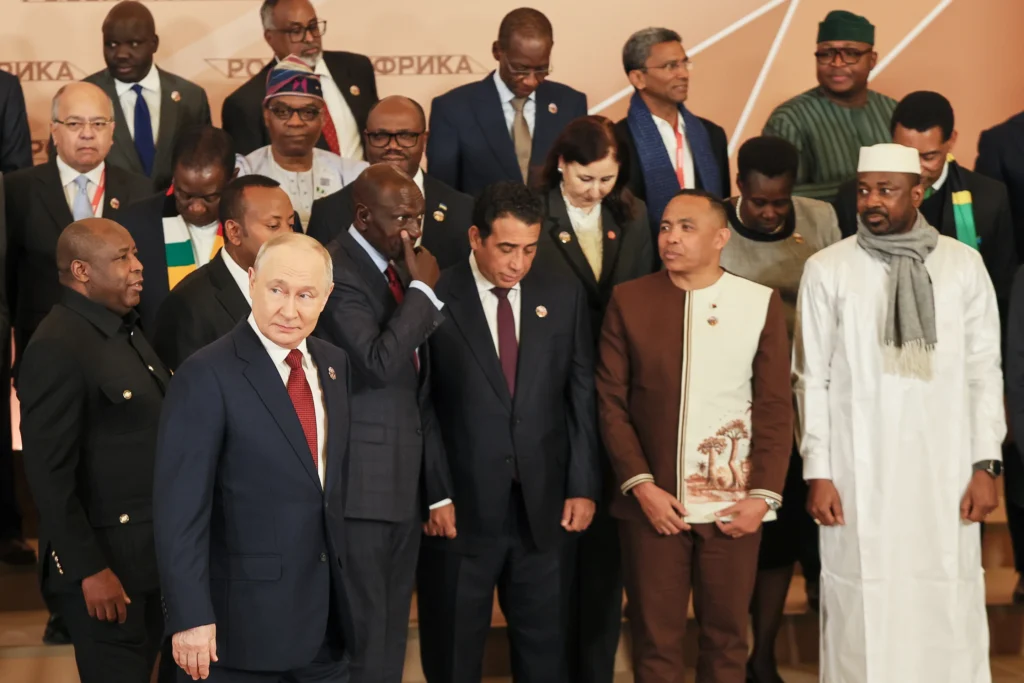
Russia is seeking to expand its influence across Africa as President Vladimir Putin hosts the third Russia-Africa Summit in Moscow, with trade, investment, security and food supplies among the major issues on the agenda.
The two-day summit, held on October 28 and 29, has drawn representatives from 48 African countries, including 22 heads of state, according to Kremlin aide Yury Ushakov. The gathering brings together African governments and Russian officials at a time when Moscow is seeking to strengthen its partnerships across the continent.

Russia Pitches Itself as an Alternative Partner
Speaking at the summit, Putin presented Russia as a reliable partner for African countries and criticised Western powers over what he described as continuing attempts to exploit the continent through unequal economic relationships and debt.
“Africa is increasingly asserting itself as one of the key players in the global economy and politics,” Putin said “However, the emergence of a multipolar world is, of course, no easy task; it faces resistance from countries that are not prepared to accept this reality.”
Putin said Russian businesses do not engage in “predatory, neo-colonial exploitation of natural and human resources” and instead expand local processing of raw materials to create jobs and tax revenue.
Moscow is also promoting its historical ties with African countries, pointing to Soviet-era support for anti-colonial movements as part of its argument for closer relations.
However, the summit is taking place amid competition for African partnerships among Russia, China, the United States and European countries. Expanding diplomatic ties does not automatically translate into increased investment or improved economic conditions for African populations.
Trade, Food and Energy Take Centre Stage
Russia is seeking wider cooperation in sectors including mining, energy, industrial development, logistics, healthcare, and education.
Putin said bilateral trade exceeded $27 billion in 2025, up 1.5 times from the previous summit in 2023, and set a target of $50 billion. He also cited grain deliveries of more than 18 million metric tonnes to Africa in 2025, with 13 million tonnes shipped in the first nine months of 2026.
Food security remains an important issue for many African countries exposed to fluctuations in global commodity prices, supply disruptions, and the cost of agricultural inputs. Greater access to grain and fertiliser could be valuable, although the benefits will depend on prices, delivery arrangements, and the needs of individual countries.
The summit’s broader programme also includes discussions on technology transfer, energy security, investment, and youth exchanges, according to Al Jazeera.
What African Governments Will Need to Consider
For African governments, the central question is how diplomatic agreements will translate into measurable economic outcomes.
Partnerships that improve access to markets, strengthen local industries, support agricultural production, and create jobs could offer long-term benefits. Governments will also need to assess financing terms, implementation timelines, and the wider implications of security and defence agreements.
Analysts have noted that Russia’s economic offer to Africa remains limited compared with other global powers. Russia’s trade with Africa was about $28 billion in 2025, compared with China’s $348 billion.
“The economic incentives to go for the Russia summit are much more limited,” said Beverly Ochieng, a Dakar-based analyst. “The political incentives for attending are the primary reasons why these countries are there.”
Trivane View
Africa’s relationships with global powers should be judged by what they deliver to African citizens, not simply by the promises made at high-level meetings. Russia’s renewed engagement creates opportunities for cooperation, but African governments must pursue transparent agreements that protect national interests and produce tangible development gains.