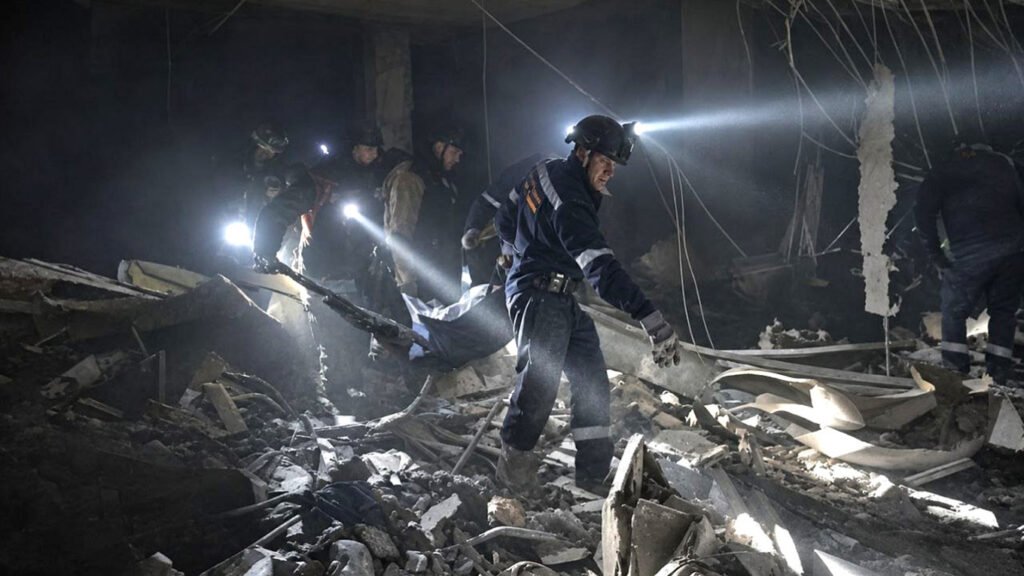
The reported death toll from Russian strikes on an aid distribution centre and nearby shelter in southeastern Ukraine rose on Tuesday, 3 November 2026, as rescuers continued searching for people believed to be trapped or missing. The attack struck Komyshuvakha in the Zaporizhzhia region on Monday, hitting a former school that residents used to collect humanitarian supplies. The updated numbers are a new development, not a separate attack at the same site.
Associated Press reported that at least 31 people had died and more than 45 remained missing after the bombing, according to Ukrainian authorities. Among the dead were police officers and rescue personnel. The figures were higher than preliminary totals issued on Monday and may change as responders reach damaged parts of the site. Statements from Ukrainian officials establish what those authorities are reporting; the complete circumstances and military decision-making have not been independently reconstructed.
What Happened at the Humanitarian Site?
Ukraine’s president, Volodymyr Zelenskyy, said bombs first struck a building used for aid distribution and later hit a neighbouring shelter. Residents had gathered for assistance in a community close to the front line, where ordinary schooling had been disrupted. Emergency responders searched collapsed structures and attempted to reach people beneath the debris while facing continuing security threats in the vicinity.
The Moscow Times, carrying Reuters reporting on Tuesday, said regional authorities had raised the death toll to at least 31, with almost 50 others still missing. The account described a second strike after the initial impact. Ukraine says the building’s humanitarian role was known locally; that claim and any allegation of deliberate targeting must be distinguished from findings of an independent investigation into the strike and its intended target.

Why Have the Casualty Figures Changed?
Information following mass-casualty attacks often arrives in stages. Local responders may initially count recovered bodies and known hospital patients while people who were inside destroyed buildings remain unaccounted for. Lists of missing people can change as families contact authorities or survivors are located. Newsrooms should therefore include a time reference and an identified source whenever publishing a casualty number.
Channel NewsAsia reported an earlier Tuesday toll of at least 29 people and said dozens remained missing as attacks elsewhere in Ukraine damaged infrastructure and forced evacuations from medical facilities. That figure does not necessarily contradict later reports of 31 deaths: it reflects the timing of the information available to the outlet. Editors should avoid combining casualty totals from different timestamps or presenting older estimates as the latest confirmed assessment.
What Does the Attack Mean for Civilian Protection?
An aid centre serving people in a conflict zone presents acute civilian-protection questions. International humanitarian law requires parties to distinguish civilians and civilian objects from military targets and to take precautions against harm. A building’s former use as a school does not by itself settle its legal status at the moment of attack; the relevant facts concern its actual use, whether it was a military objective and the precautions taken.
Survivors may lose access to food and assistance if a distribution site is destroyed, while repeated strikes can prevent humanitarian teams from reaching isolated communities. Attribution requires independent investigation.
The timing has renewed attention to US-mediated discussions expected in Abu Dhabi on 10 and 11 November. Talks involving Ukraine, Russia and American officials could address security and humanitarian arrangements, but a scheduled meeting does not signal an agreement to halt attacks. Zelenskyy criticised the bombing as incompatible with de-escalation. Russia’s wider statements about its military campaign should likewise be reported as its position, not an explanation independently proven for the destruction of the aid site.
What Happens Next?
The urgent developments are the search for missing people, additional verified casualty totals, medical care for survivors and arrangements to restore assistance to affected residents. Diplomats will also be watching whether the attack changes the tone or agenda of the planned talks. Any independent inquiry should seek physical evidence, witness accounts and military records capable of establishing the sequence and legal status of the targets.
Trivane View
Attacks on locations serving civilians demand transparent investigation, especially when aid workers and rescue personnel are reported among the dead. Claims about intent must be tested against evidence, while the immediate humanitarian priorities are recovering those missing, treating survivors and restoring access to essential assistance.
Related Trivane News
Ukraine Air Raid Alert App Sends False Nuclear Warnings
Trump Envoy Meets Putin as Washington Renews Peace Push