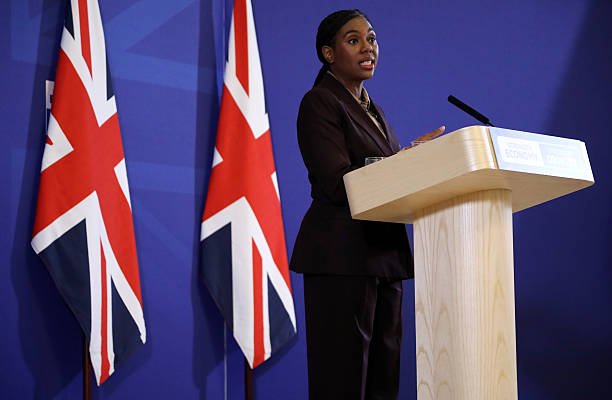
British Conservative Party leader Kemi Badenoch has condemned remarks referring to her Nigerian background as part of a bitter political dispute involving figures associated with Reform UK. Nigerian media continued covering the exchange on Saturday, 31 October 2026, after Badenoch responded publicly during a television interview on Thursday.
PUNCH reported on Saturday that Raheem Kassam, a former aide to Nigel Farage, had posted accusations calling Badenoch a scammer and referring to her Nigerian background. Badenoch described the racial dimension of the remarks as an attack that would not undermine her. The accusations are political statements, not findings of wrongdoing.
What Sparked the Dispute?
Kassam’s online posts criticised Badenoch’s credibility and suggested that she had used her Nigerian upbringing when it suited her political career. The references to nationality and heritage became central to the controversy because they were presented alongside an accusation of dishonesty rather than a specific substantiated policy criticism.
TheCable, in a report published late on 30 October, said Badenoch rejected what she characterised as an attempt to use race against her. Her comments came amid renewed scrutiny of how politicians and their allies frame disputes about national identity and political legitimacy.
The disagreement also reached senior Reform figures. Nigel Farage was asked whether he regarded the language as racist, while Robert Jenrick, a former Conservative who joined Reform, declined to condemn it in the terms sought by interviewers. Their responses, like Badenoch’s interpretation, are part of a public political disagreement and should be attributed rather than simplified into a judicial conclusion.

What Did Badenoch Say in Her Response?
ITV News reported on 29 October that Badenoch addressed the controversy during Good Morning Britain. She criticised the time spent attacking her rather than discussing policies affecting residents and said attempts to weaponise her race would not succeed. Her statement also distinguished her criticism of the remarks from her broader view of Britain as a country where racial attacks do not define everyday public life.
Badenoch’s Nigerian childhood has long been part of her public biography, alongside her political career in the United Kingdom. That history can be discussed legitimately in reporting about identity, upbringing or public statements. The editorial question is whether a political attack uses those facts to supply evidence for a claim or merely to portray someone as less trustworthy because of their heritage.
Journalists covering this dispute should distinguish the offensive wording of a post, the response from the politician targeted and the positions taken by other parties. None of those elements independently proves a criminal offence or establishes the truth of the underlying personal allegations.
Why Does the Row Matter to Nigerians in Britain?
The argument touches a broader concern among Nigerians abroad: whether professional and political achievements are evaluated on conduct and evidence, or through stereotypes connected to origin. It is possible to scrutinise Badenoch’s policies or record vigorously without treating Nigerian identity itself as evidence of wrongdoing.
The row also illustrates the tension between a politician’s chosen public identity and the way opponents characterise it. Badenoch has made claims about Britain, immigration and national belonging that attract both support and disagreement. Those positions remain open to factual challenge, but nationality-based labels do not substitute for substantive debate.
For diaspora readers, the episode raises questions about representation and inclusion without making any one politician a spokesperson for all British Nigerians. The community holds diverse political beliefs, and an individual leader’s record should not be mistaken for the collective experience of migrants and their descendants.
What Happens Next?
The immediate question is whether Reform figures, Kassam or Badenoch make further statements, and whether the dispute influences discussion of policy or remains focused on personal attacks. Any new allegation should be checked against evidence and a right of reply. The remarks at issue were made earlier in the week, so Saturday’s reports are follow-up coverage, not a newly occurring incident.
Trivane View
Public figures should face robust scrutiny, including criticism of their decisions and claims. But national origin is not proof of dishonesty. Responsible reporting should hold all sides to the same evidentiary standard while avoiding stereotypes that unfairly implicate wider diaspora communities.
Related Trivane News
Nigerian Entrepreneur Yemi Edun Makes UK Powerlist for Seventh Year
Nigerians in UK Get More Time for Passports as Exercise Runs to November 27
Nigeria’s New Envoy in South Africa Promises Protection