
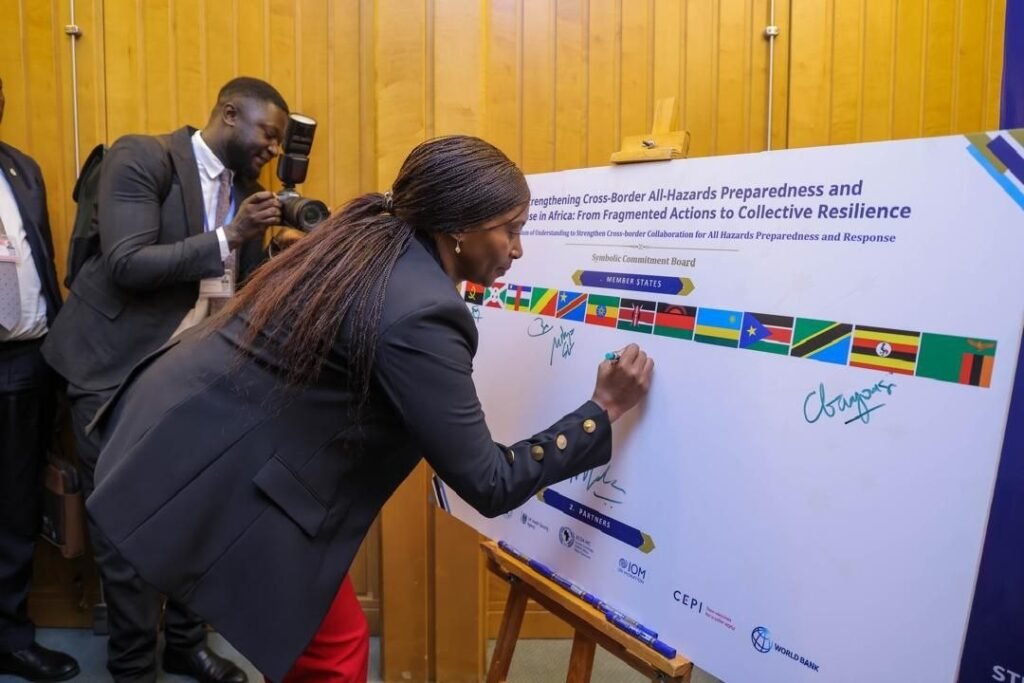
Ten African countries have signed an agreement to strengthen cooperation when disease outbreaks and other public health emergencies threaten to spread across national borders.
The Cross-Border Collaboration Memorandum of Understanding is intended to improve coordination, information-sharing, preparedness and joint responses between participating countries.
The World Health Organization Regional Office for Africa announced the agreement on 3 September, saying it provides a framework for countries to cooperate before, during and after health emergencies.
The agreement itself was signed during a high-level meeting in Addis Ababa on 27 August, on the sidelines of the 76th session of the WHO Regional Committee for Africa. The meeting was organised by WHO Africa, the World Bank, Africa Centres for Disease Control and Prevention and Gavi, the Vaccine Alliance.
Why borders matter during disease outbreaks
Disease outbreaks can become regional emergencies when infected people move between countries before cases are detected.
Trade routes, migration, displacement and communities living across national boundaries can make controlling an outbreak particularly difficult. Border communities may also depend on health facilities, markets and family networks on both sides of a frontier.
Africa has experienced this problem repeatedly with diseases including Ebola, mpox, cholera and Marburg virus disease.
In May, health officials from 13 countries met in Brazzaville to develop the cross-border framework. WHO said at the time that increasing population movement, humanitarian emergencies and climate-related shocks had made stronger cooperation increasingly important.
The new agreement is designed to move countries away from relying mainly on emergency cooperation after an outbreak has already escalated.
Instead, participating governments are expected to establish systems that can support earlier detection, clearer responsibilities and faster joint action.
Recent Ebola outbreaks exposed the risks
The agreement comes against the backdrop of serious disease outbreaks across parts of the continent.
Cross-border coordination became particularly important during the 2026 Bundibugyo virus disease outbreak in the Democratic Republic of the Congo.
In May, health ministers and officials from the DRC, Uganda and South Sudan met to strengthen regional coordination as the outbreak developed. Their discussions covered surveillance, laboratory systems, contact tracing, infection prevention and community engagement.
A further meeting in Bangui in August brought together the Central African Republic, DRC, Republic of the Congo, South Sudan and Uganda.
Officials discussed stronger surveillance at points of entry, faster sharing of health information and closer engagement with border communities.
Those meetings helped build the groundwork for the wider agreement now signed in Addis Ababa.
Information-sharing will be central
One of the most important parts of the new framework is the commitment to improve information-sharing.
Speed can determine whether an outbreak is contained locally or spreads much further.
If neighbouring countries receive information quickly, health authorities can strengthen surveillance, alert hospitals and laboratories, prepare border communities and investigate suspected cases earlier.
The agreement also seeks to clarify responsibilities between countries so that joint action does not depend on arrangements being created from scratch during every emergency.
WHO Regional Director for Africa Dr Mohamed Janabi said countries need systems, capacity and partnerships in place before emergencies happen if they are to detect threats and respond effectively.
Preparedness will still require investment
Signing an agreement does not automatically give countries the laboratories, surveillance systems, trained personnel or emergency supplies needed to contain outbreaks.
Financing will therefore be a major test.
At the Addis Ababa meeting, the World Bank called for stronger investment in health systems, surveillance and cross-border coordination before emergencies occur.
Partners also discussed access to medical tools. The Coalition for Epidemic Preparedness Innovations said it is investing US$16.5 million in the production of vaccines targeting Bundibugyo virus disease.
The same meeting also included the announcement of a global mpox vaccine stockpile. WHO said the mechanism is expected to begin operating later in September and is intended to support faster and more equitable access to vaccines during outbreaks.
From agreement to action at the border
The significance of the new framework will ultimately depend on what happens away from ministerial meetings.
Border health facilities need functioning surveillance systems. Laboratories need the capacity to process samples quickly. Countries need reliable channels for sharing information, while emergency teams must be able to coordinate when cases appear on different sides of a border.
Governments will also need to maintain cooperation between outbreaks rather than waiting for the next emergency.
Trivane View: Cooperation must work before the next outbreak
The agreement is an important step because disease outbreaks do not follow national boundaries.
But its real value will depend on implementation.
African countries have experienced repeated outbreaks that demonstrate how quickly a local health emergency can become a regional threat. Agreements signed at continental meetings matter only when they produce faster alerts, stronger border surveillance and practical cooperation on the ground.
The test will come when the next cross-border threat emerges. By then, the systems promised in Addis Ababa should already be working.
Source: WHO Regional Office for Africa – Cross-border cooperation for health emergencies
Facts first. Not frenzy.