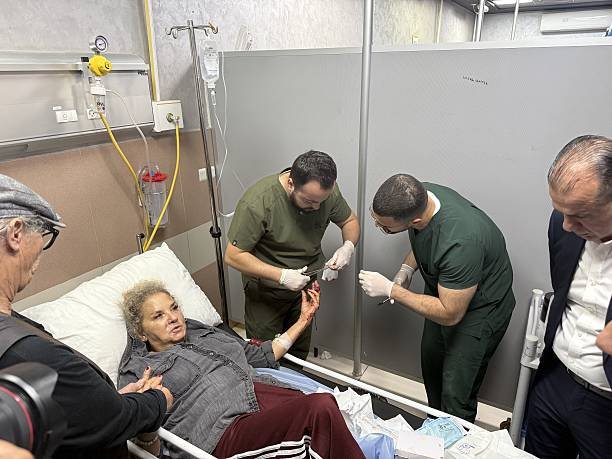
A veteran American photojournalist working for The Washington Post has suffered serious injuries after masked Israeli settlers attacked Palestinian olive harvesters near the village of Abu Falah, northeast of Ramallah, in the occupied West Bank.
Heidi Levine was covering the annual olive harvest on Friday, 16 October 2026, when dozens of masked men descended on the area, throwing stones and setting olive groves alight.
According to The Washington Post, Levine was wearing protective equipment identifying her as a journalist when she was knocked to the ground and repeatedly kicked.
Several Palestinians were also reported injured during the violence.
The attack has prompted condemnation from press freedom advocates and American officials, while Israeli authorities have opened an investigation.

Photographer describes violent assault
Levine, an experienced photojournalist who has covered conflicts across the Middle East and elsewhere, described the attack while receiving medical treatment.
She said she saw at least 50 masked men approaching from a nearby hilltop before they began attacking people at the olive harvest.
Levine said she was pushed to the ground and repeatedly kicked, even as she wore a protective helmet and vest.
She also reported that attackers took her cameras and phone. Other belongings, including her passport and wallet, were reported stolen.
Palestinian colleagues helped her escape the assault and obtain medical treatment.
The Washington Post subsequently reported that Levine had sustained four fractured vertebrae, a broken rib, and lacerations across her body. She received treatment in Ramallah and in Israel.
The newspaper condemned the attack and called for a thorough investigation.
Its executive editor, Matt Murray, expressed relief that Levine had received medical care but said the violence against a journalist carrying out her work was unacceptable.
Violence spreads across olive-growing communities.
The attack near Abu Falah formed part of a wider series of assaults reported across Palestinian communities during the olive harvest.
According to The Guardian, settlers attacked farmers in several locations, damaging trees, burning vehicles and injuring residents.
The Israeli human rights organisation Yesh Din recorded at least 170 settler attacks from 27 September, around the beginning of the harvest season, according to the newspaper’s reporting.
That figure covers a specified reporting period and should not be interpreted as the number of attacks on 16 October alone.
The olive harvest is an important source of income for many Palestinian families. Olive trees can remain productive for generations, making damage to groves particularly harmful to farming communities.
Attacks on harvesters can also prevent families from reaching their land, collecting crops, and maintaining their livelihoods.
The annual harvest has repeatedly become a flashpoint amid disputes over land access, Israeli settlement activity, and the protection of Palestinian civilians in the occupied West Bank.
Questions over security forces’ response.
Witness accounts and video footage have raised questions about the response of Israeli security forces during the assault.
The Washington Post reported allegations that soldiers were present nearby but did not intervene to stop the violence.
Those allegations require investigation to establish what individual soldiers saw, what actions they took, and whether any official procedures were breached.
Israeli Prime Minister Benjamin Netanyahu said the circumstances of the incident remained unclear and were under investigation.
According to ABC News, Israeli police opened an investigation into the attack.
The existence of an investigation does not establish that suspects have been identified, arrested, or prosecuted.
US officials and press freedom advocates respond
The US Embassy in Jerusalem condemned criminal violence in the West Bank and said it was monitoring the incident.
American lawmakers also called for accountability following the attack on Levine.
The Committee to Protect Journalists condemned the assault and warned that journalists covering the olive harvest face a wider pattern of violence and intimidation.
The incident has raised concerns about whether reporters can safely document attacks on civilians, particularly in areas where access and security are already difficult.
Journalists covering such incidents are entitled to protection against violence. Their visible press identification is an important safeguard, although it does not eliminate the risks of reporting in volatile areas.
Investigation and accountability
The immediate priority is establishing the full circumstances of the assault, including the identities of those responsible and the conduct of security personnel at the scene.
The attack also highlights the continuing danger faced by Palestinian farmers during the harvest season.
Damage to olive trees, loss of agricultural income, and restrictions on access to farmland can have consequences long after the immediate violence ends.
Israeli authorities’ investigation will be closely watched for evidence of meaningful accountability.
The injuries suffered by Levine have brought international attention to the incident, but the safety of Palestinian harvesters and other journalists remains a broader concern across the occupied West Bank.