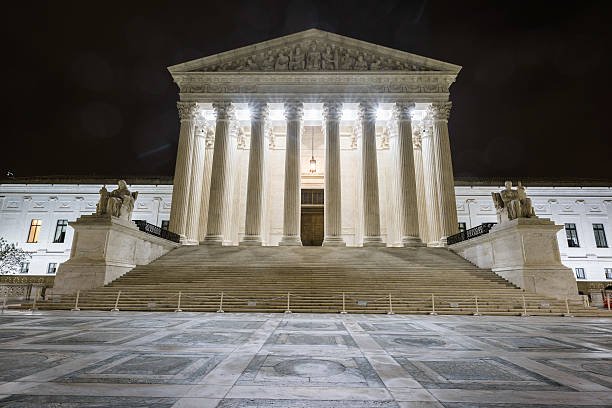
The US Supreme Court on Monday, October 19, declined to hear a challenge brought by the publishing arms of BMG, Sony Music, Universal Music Group and Warner Music over a ruling on the international reach of US copyright termination rights.
According to “Reuters“, the dispute concerns whether songwriters can use a provision of US copyright law to reclaim rights to their work outside the United States, rather than only within the country.
The decision leaves standing a ruling by the US Court of Appeals for the Fifth Circuit that favoured songwriter Cyril Vetter. However, the Supreme Court did not issue a new ruling on the underlying legal question.
The Dispute Behind “Double Shot”
Vetter co-wrote “Double Shot (Of My Baby’s Love)” with Donald Smith in 1962. The song became best known through a 1966 recording by the Swingin’ Medallions.
Vetter and Smith transferred their copyrights to Windsong Music Publishers in 1963. Vetter later sought to reclaim his rights under a provision of US copyright law that allows creators, under certain conditions, to terminate earlier copyright transfers after a specified period.
He sent a termination notice in 2019 that took effect in 2022. After a subsequent dispute over the rights to the song outside the United States, Vetter sued Resnik Music Group, which had acquired Windsong, in 2023.
A federal district court ruled in Vetter’s favour in 2025, declaring him the owner of the reclaimed copyright worldwide. The Fifth Circuit upheld that decision in January 2026.
Why the Music Labels Challenged the Ruling
The music publishers argued that applying US copyright termination rights to foreign copyrights could disrupt established industry practices and affect agreements worth billions of dollars.
Their challenge sought to overturn the lower court’s interpretation of the law, which they argued differed from the industry’s longstanding understanding of how copyright transfers operate internationally.

Vetter’s lawyers, however, argued that the labels’ concerns about the consequences of the ruling were overstated.
The Supreme Court’s decision not to hear the case means the Fifth Circuit’s ruling remains in place. Reuters reported that four of the nine justices did not participate in considering the appeal, and the remaining justices determined that the case could not be resolved in the coming term.
What the Decision Means for Songwriters
US copyright law gives eligible creators a route to reclaim certain rights they previously transferred, provided statutory conditions and time limits are met. The provisions were designed in part to give creators another opportunity to benefit from works that may have become more valuable over time.
The outcome of Vetter’s case strengthens his position in the specific dispute and leaves the lower court’s international interpretation intact. It does not mean that every songwriter can automatically reclaim every copyright worldwide; eligibility depends on the law and the circumstances of each agreement.
The case highlights a continuing tension in the music industry between the contractual rights of publishers and the ability of songwriters to recover control over older works.
For now, the lower court ruling stands, while the broader implications for international music-rights agreements will depend on how the decision is applied in future disputes.