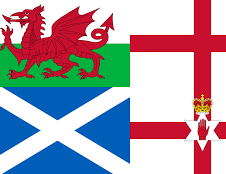
The leaders of the governing parties in Scotland, Wales and Northern Ireland are expected to sign a joint declaration calling for their nations to have the right to determine their constitutional futures.
Rhun ap Iorwerth of Plaid Cymru, John Swinney of the Scottish National Party and Michelle O’Neill of Sinn Féin are due to meet in Cardiff on Monday, September 14.
Although all three are First Ministers, they will attend the meeting in their capacities as party leaders rather than as representatives at a formal meeting of the devolved governments.
What the leaders are expected to sign
According to a Press Association report published by Nation.Cymru, the three leaders are expected to sign a memorandum of understanding supporting the right of people in their respective nations to decide their constitutional futures through democratic means.
The declaration is expected to increase pressure on the UK Government to recognise demands for future referendums.
The meeting will also consider areas where the three parties and their governments could work together. These include public funding, economic policy, energy, relations with Europe and greater powers for the devolved nations.
Ap Iorwerth told the BBC that the leaders would discuss what they had in common as well as the issues on which they disagreed. He identified fair funding, greater powers and a different relationship with the UK Government as important areas of discussion.
A Sinn Féin source told the Press Association that the meeting would consider how each nation could shape its future through democratic means and according to the wishes of its people.
Not an immediate break-up of the UK
Some reports have described the Cardiff meeting as a fresh attempt to break up the United Kingdom. That description goes further than the confirmed facts.
The declaration would be a political statement. It would not dissolve the UK, create an automatic right to hold referendums or immediately change the constitutional position of Scotland, Wales or Northern Ireland.
In an interview with The Guardian, Ap Iorwerth rejected claims that the meeting was simply about plotting the end of the UK.
He said his objective was to strengthen Wales and argued that the country’s constitutional future should ultimately be decided by the Welsh people. Plaid Cymru supports Welsh independence but has not set an immediate timetable for a referendum.
Different legal routes to constitutional change
The three nations do not have identical legal routes to constitutional change.
Northern Ireland already has a mechanism for a border poll under the Good Friday Agreement and the Northern Ireland Act 1998. Such a vote would concern whether Northern Ireland should remain within the UK or become part of a united Ireland.
Scotland does not have the same mechanism. In 2022, the UK Supreme Court ruled that the Scottish Parliament could not legislate unilaterally for an independence referendum because the Union and the UK Parliament are reserved matters.
A legally recognised Scottish referendum would therefore require agreement or legislative action from Westminster unless the existing constitutional arrangements were changed.
Wales would also need cooperation from the UK Parliament for a legally recognised independence referendum.
UK Government maintains its opposition
The UK Government has continued to oppose fresh referendums on leaving the Union.
The Cardiff meeting follows conflicting political signals from Prime Minister Andy Burnham. His earlier comments about the possibility of another Scottish referendum led to renewed calls for a clear legal route to a vote.
However, Downing Street later said government policy had not changed. Burnham subsequently told Swinney that another Scottish independence referendum remained off limits because the government did not believe there was a clear public consensus for one.
Monday’s declaration is therefore likely to increase political pressure on Westminster, but it will not compel the UK Government to approve a referendum.
Trivane View
The Cardiff meeting is constitutionally significant, but it should not be reported as an immediate plan to break up the UK. The declaration is expected to strengthen political cooperation between three pro-independence parties and demand democratic routes to constitutional change. Its practical effect will depend on its final wording and the UK Government’s response.