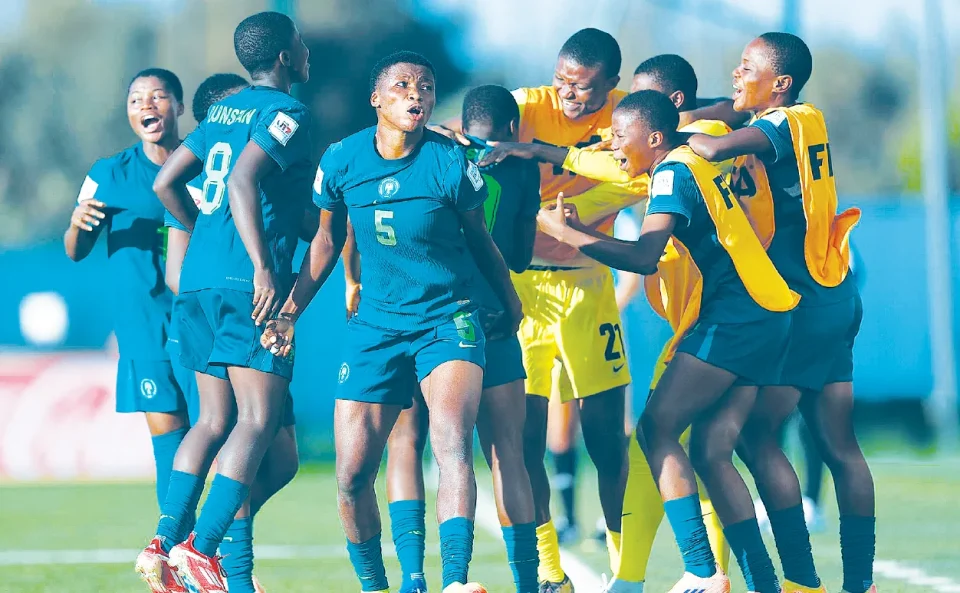
Nigeria’s Flamingos defeated defending champions North Korea 3-1 in their final Group B match at the 2026 FIFA Under-17 Women’s World Cup in Morocco, securing a place in the round of 16. The PUNCH reported the result in its Saturday, 24 October edition, while The Guardian published a separate account early the same morning. The match itself took place on Friday, 23 October, and should not be misrepresented as a Saturday fixture. Nigeria finished second in the group with six points. The victory was especially notable because North Korea entered as the reigning champions and had scored heavily in their earlier matches.

How Did Nigeria Build the Lead?
According to The PUNCH, Oluwakemi Adegbuyi opened the scoring in the 15th minute, before Oluebube Umejiaku doubled Nigeria’s advantage in the 38th. Kanyisola Yusuf added a third after the interval, giving the Flamingos a commanding lead. The Guardian also credited those three players with Nigeria’s goals, although its account described Yusuf’s effort as a free-kick while The PUNCH’s summary did not provide that detail. Both reports agree that North Korea reduced the deficit late through a penalty scored by Yu Jong-hyang. Where accounts differ over the build-up to a goal, official match footage or FIFA’s match report should settle the detail.
Why Was This Such a Difficult Assignment?
North Korea had beaten Puerto Rico 6-0 and Poland 6-1 before facing Nigeria, according to The PUNCH. That record made the defending champions formidable opponents, especially for a Nigerian side that had already lost once in the group. Nigeria’s ability to take an early lead changed the pressure on both teams: the Flamingos could defend their advantage while North Korea had to chase the match. Yet the result does not mean North Korea were eliminated. Both sides advanced, with the Koreans finishing first in the group and Nigeria second.
How Did Nigeria Recover From Its Opening Setback?
The PUNCH reported that Nigeria began with a 2-1 defeat to Poland before beating Puerto Rico 2-0. That left qualification dependent on the final group game. The Guardian’s report, however, referred to the opening loss as being against Portugal, an inconsistency that requires checking against FIFA’s official fixture record before publication. For now, the defensible conclusion is that Nigeria rebounded from an opening defeat and earned six points from three games. Editors should not repeat the conflicting opponent detail as certain without further verification.
What Does Qualification Mean for the Team?
Advancing to the knockout round gives the young Nigerian players another opportunity to compete against elite international opposition. The PUNCH noted that the Flamingos previously won bronze at the 2022 edition. That history creates expectations but does not establish the likelihood of another medal. Youth competitions are also development opportunities: coaches can assess how players respond to high-pressure games, unfamiliar opponents and short recovery periods. One impressive win is evidence of what the team achieved on the day, not a guarantee of continued success.
Who Will Nigeria Face Next?
The Guardian reported that Nigeria would face the runners-up from Group F in the next round, with the match scheduled for Thursday. The precise opponent was not confirmed in the reports reviewed and should be checked against FIFA’s final bracket rather than inferred from provisional standings. Teams can change positions until all group fixtures are complete. For readers planning to follow the game, the confirmed opponent, kickoff time and venue should come from an official fixture update. Speculation about the draw would add little value.
What Should Editors Verify Before Publication?
The two available match accounts agree on the final score, goalscorers and Nigeria’s qualification, but contain conflicting details about Nigeria’s opening opponent and the manner of the third goal. An editor should consult the official FIFA match centre and competition schedule before finalising those particulars. This is especially important in a knockout tournament where a single inaccurate opponent or kickoff date can mislead supporters. There is also a freshness limitation: although the coverage appeared in Saturday editions, the match took place on Friday. If the handover requires events that happened on Saturday itself, this article should be held as a backup rather than presented as a fully compliant selection.
What Happens Next?
Nigeria’s immediate priorities are recovery, analysis of the next opponent and preparation for a knockout match where one defeat ends the campaign. The coaching staff will also need to examine the defensive lapse that led to North Korea’s late penalty while preserving the attacking effectiveness shown in the first three goals. For Trivane readers, the next meaningful development will be the confirmed round-of-16 fixture and any official squad updates. This story is based on reports published Saturday about a match played Friday; it is not a new Saturday result.
Related Trivane coverage
Super Falcons Fall Seven Places in Rankings