
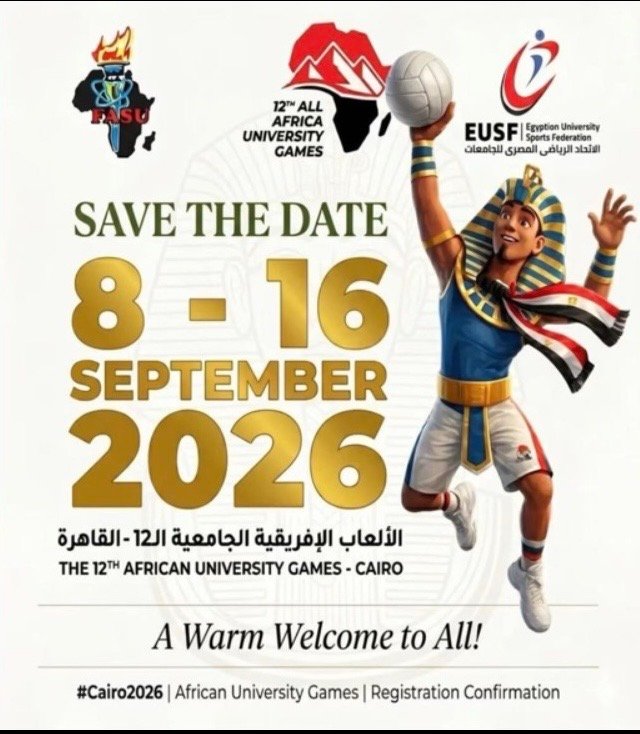
Cairo is preparing to welcome student athletes from across Africa for the 12th All Africa University Games, one of the continent’s biggest university sporting events.
The Games, widely known as the FASU Games, will take place from September 8 to 16, 2026, with competitions spread across universities and sporting facilities in Greater Cairo.
Around 2,000 athletes and officials from 81 universities in 17 African countries are expected to take part, according to the latest information from Egypt’s State Information Service. The event will feature 18 main sports, alongside para-sports and recreational activities.
It will be the first time Egypt has hosted the FASU Games.
What are the FASU Games?
The All Africa University Games bring together student athletes from universities across the continent to compete in different sports.
The Games are organised with the Federation of Africa University Sports, known as FASU. They provide a continental platform for university athletes while also encouraging cooperation between universities and students from different African countries.
Cairo 2026 is being organised with the involvement of Egypt’s Ministry of Higher Education and Scientific Research, the Ministry of Youth and Sports, FASU and the Egyptian University Sports Federation.
Nigeria is among the countries taking part. The Nigerian University Games Association has been involved in preparations for the event and has encouraged Nigerian universities to participate.
18 sports on the programme
Athletes will compete across 18 main sporting disciplines during the Games.
The programme includes athletics, basketball, football, futsal, volleyball, swimming, badminton, table tennis, tennis, squash, chess, judo, karate, taekwondo, wrestling, fencing, padel and modern pentathlon.
Para-athletics, para-badminton, para-swimming and para-table tennis are also included in the wider programme.
Football is expected to be one of the major attractions. FISU says the football competition also provides a route towards qualification for its University World Cup.
The wide range of sports means the Games will bring together athletes with different skills and backgrounds, from team sports such as football and basketball to individual events including athletics, swimming and martial arts.
Cairo prepares its venues
Competitions and other activities will take place at several locations across Greater Cairo.
Cairo University has played a central role in preparations, while a number of other universities and sporting facilities are supporting the event.
The American University in Cairo, the British University in Egypt, Ain Shams University and Helwan University have all been involved in preparations. Facilities in the New Administrative Capital are also expected to host activities connected to the Games.
Helwan University was earlier identified as the location of a main sports village, with accommodation for about 1,200 participants.
Organisers have also been working on transport, accommodation and competition facilities ahead of the arrival of athletes and officials.
A torch relay through Egyptian universities has added to preparations for the opening, helping to promote the Games among students before competition begins.
An Egyptian identity for Cairo 2026
Egypt’s history and culture are also part of the identity of the Games.
The official mascot, Tut, takes its inspiration from Tutankhamun and ancient Egyptian civilisation. Organisers say the mascot represents qualities including youth, strength and leadership while giving the competition a clear connection to its host country.
But Cairo 2026 is designed to offer more than medals and sporting competition.
Activities linked to the Games include a scientific conference, a forum involving university leaders and a FASU-FISU seminar. These events are intended to encourage discussion about the development and management of university sport across Africa.
The Games will also give students from different countries an opportunity to meet and build relationships away from the competition venues.
Why the Games matter
For student athletes, the FASU Games provide an opportunity to represent their universities on a major continental stage.
Many will compete against athletes from countries they may never have visited, while sharing the experience with students who combine education with high-level sport.
For Egypt, hosting the event is another chance to demonstrate its ability to organise a large African sporting competition and welcome thousands of visitors connected to university sport.
The Games could also have wider importance for Africa.
FISU President Leonz Eder has previously said that successfully hosting major university sporting events could strengthen Africa’s chances of eventually hosting the World University Games for the first time.
With the opening approaching, attention is now turning from preparations to competition.
From September 8, Cairo will become a meeting point for university athletes from across Africa, with nine days of sport, cultural exchange and new connections between students from different parts of the continent.
Sources: Federation of Africa University Sports (FASU); International University Sports Federation (FISU); Egypt State Information Service; Nigerian University Games Association (NUGA); Daily News Egypt.
Facts first. Not frenzy.