Africa Centres for Disease Control and Prevention says a team of senior Ebola scientists will travel to Abuja to investigate the source of Nigeria’s imported Bundibugyo Ebola infection. Reuters reported the announcement on Monday, 26 October, attributing it to Africa CDC director-general Jean Kaseya. The planned team will include Jean-Jacques Muyembe, a scientist associated with the original discovery of Ebola. The investigation is distinct from the earlier contact-tracing announcement and from Monday’s medical evacuation of the patient to Switzerland.
Why Is the Source of Infection Unclear?
The patient, a woman who had travelled through Uganda, had not visited the known outbreak epicentre in the Democratic Republic of Congo, according to Reuters. Investigators are examining a possible link with a Kenyan case because genetic sequencing reportedly found closely related viruses. The two patients may have passed through Entebbe airport on 3 October on flights separated by about 40 minutes. That overlap is a lead, not proof of direct contact or transmission at the airport. Genomic similarity can help identify relationships between infections, but it cannot by itself show exactly where or from whom a person acquired the virus.

What Will the Scientists Examine?
The specialist team is expected to review viral genetic evidence, travel histories, exposure opportunities, and the possibility of undetected infections along the relevant routes. The findings could help public health agencies decide whether to expand contact investigations or strengthen screening and surveillance at particular points of travel. A credible investigation must also account for incomplete records and the incubation period. Authorities have not announced a definitive source of infection, and no location should be labelled an established transmission site without supporting evidence.
What Is Nigeria’s Current Situation?
Health Minister Muhammad Pate confirmed that the patient was evacuated to Switzerland with her husband on Monday. He said she had improved clinically but warned that improvement did not necessarily mean she had ceased to be infectious. Associated Press reported that Nigeria continued to monitor 52 other contacts and had no active cases after the evacuation. The absence of a patient physically present in Nigeria is not equivalent to the end of all transmission risk; surveillance remains important until the appropriate follow-up periods are completed.
How Does the Outbreak Affect Regional Preparedness?
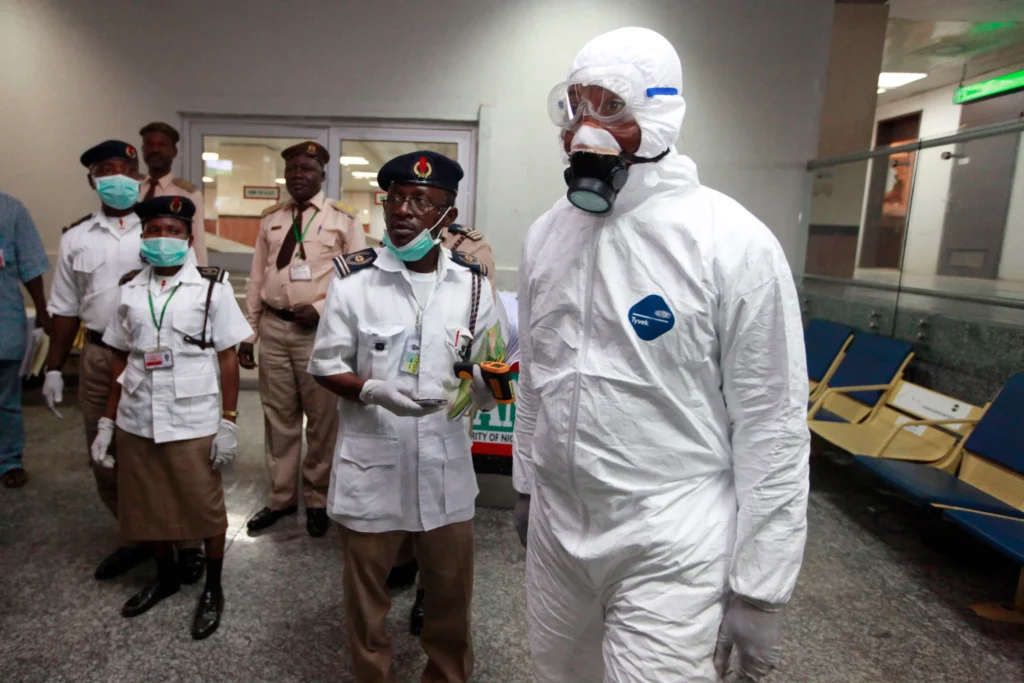
The investigation involves countries connected by frequent travel and demonstrates why an outbreak response cannot stop at national borders. Nigeria’s NCDC said on Sunday that its response includes contact tracing, laboratory work, infection prevention and coordination with partners. Reuters reported that the Bundibugyo strain lacks an approved vaccine or treatment, increasing the importance of rapid identification and supportive clinical care. For readers, practical information should come from official health agencies rather than speculation about particular passengers, ethnic groups, or travel routes.
Why Does Contact Tracing Continue After Evacuation?
Contact monitoring is designed to identify symptoms quickly among people who may have been exposed during the period when a patient could transmit the virus. The number of contacts under observation is therefore not a count of new infections. It can change as investigators interview patients, review movements, and refine risk assessments. Public health agencies may also classify contacts by exposure level, which affects follow-up arrangements. For the public, the safest interpretation is that the response remains active even when officials say that no confirmed patient remains inside the country. Authorities should explain the monitoring timetable, the procedure for reporting symptoms, and how suspected cases will be tested. These practical details are more useful than treating an international medical evacuation as a declaration that the threat has disappeared.
What Happens Next?
Africa CDC and national authorities are expected to analyse the evidence and explain whether they can establish a plausible transmission chain. Journalists should ask when the team arrives, what findings are peer-reviewed or independently corroborated, and whether any additional contacts require monitoring. Any change in Nigeria’s case count should be dated and attributed to a named public health authority.
Trivane View
The central accountability issue is not merely how quickly officials moved a patient abroad. It is whether the investigation produces an evidence-based account of exposure, identifies any surveillance gaps, and communicates uncertainty without creating panic. Transparent updates are essential to public trust, especially when scientific clues are preliminary.