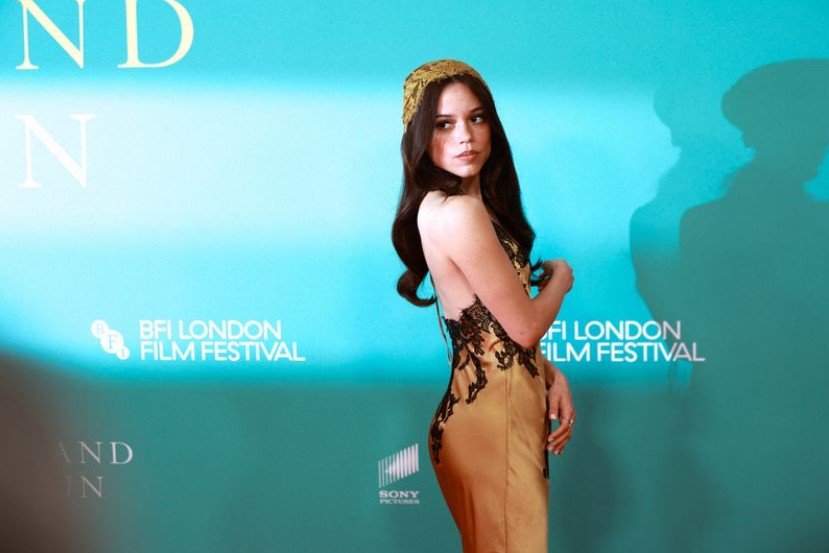
Jenna Ortega’s new film Klara and the Sun has premiered at the BFI London Film Festival, bringing a story about artificial intelligence, loneliness, and family relationships to the screen ahead of its cinema release.
The film, directed by Taika Waititi, was presented at the London festival on Thursday, 15 October 2026. It is based on the 2021 novel of the same name by Nobel Prize-winning author Kazuo Ishiguro.
Ortega plays Klara, an android created to provide companionship to people who feel isolated. Her arrival in a troubled household forms the centre of a story about love, grief, and the need for human connection.
According to Reuters’ report on the premiere, Waititi wanted to balance the emotional weight of Ishiguro’s story with moments of humour.
The film is scheduled to open in UK and US cinemas on Friday, 23 October.
Jenna Ortega takes on the role of an artificial friend
In the film, Klara is an Artificial Friend, a humanoid robot designed to offer companionship.
She is observant, hopeful, and eager to understand the people around her, even when their behaviour and emotions are difficult for her to explain.
Klara eventually becomes part of the household of Josie, played by Mia Tharia, a teenager whose family has experienced significant loss.
Josie’s relationship with her mother, played by Amy Adams, is strained by grief and the challenges facing the family.
Klara’s loyalty and curiosity begin to influence the way the family relates to one another.
The story follows her attempts to understand human emotions while offering the companionship she was created to provide.
Klara also has a strong belief in the power of the sun, which she sees as a source of energy and hope.
Her unusual view of the world gives the story another way to explore faith, care, and the desire to help others.
Rather than presenting artificial intelligence simply as a threat or a technological achievement, the film examines what happens when a machine becomes closely involved in human relationships.

Taika Waititi brings Ishiguro’s novel to the screen.
Waititi directed the adaptation and wrote the screenplay with Dahvi Waller.
The filmmaker is known for work including Jojo Rabbit, which won him an Academy Award for adapted screenplay.
Klara and the Sun combines elements of science fiction, drama, and comedy, although its central concerns are emotional rather than technological.
Ishiguro’s original novel explores the experience of an artificial companion who observes human relationships from an unusual perspective.
The film builds on that premise by placing Klara’s understanding of people at the centre of the story.
In his comments to Reuters, Waititi discussed the importance of retaining the novel’s emotional themes while introducing humour.
The adaptation arrives at a time when artificial intelligence is becoming more visible in everyday life, including through digital assistants and other tools designed to interact with people.
However, the film’s fictional Artificial Friends should not be confused with the capabilities of present-day AI systems.
Its central questions concern companionship, empathy, and the relationships people form with technology.
A cast led by Ortega and Amy Adams.
Alongside Ortega and Adams, the film stars Mia Tharia as Josie.
The cast also includes Steve Buscemi, Natasha Lyonne, and Aran Murphy.
According to Sony Pictures’ official film information, the story follows Klara as she searches for a home and forms a bond with Josie.
The studio describes the relationship between the two characters as an important part of the family’s attempt to recover from loss.
Ortega’s performance places her in a role that depends heavily on observation and emotional restraint.
Klara must respond to human experiences while remaining a character whose understanding of those experiences differs from that of the people around her.
The film therefore asks audiences to consider whether companionship depends entirely on being human, or whether people can find comfort in relationships with artificial beings.
London premiere draws attention before release
The BFI London Film Festival screening gave the film its major public introduction ahead of the wider cinema rollout.
The British Film Institute’s festival listing confirms the 15 October screening, with additional festival screenings scheduled for 16 and 17 October.
The premiere also provided an opportunity for the cast and filmmakers to discuss the adaptation before its general release.
Early critical reactions have begun to appear following the festival presentation.
Those reviews represent individual assessments of the film rather than a settled measure of how wider cinema audiences will respond.
The film’s commercial performance and broader audience reception will become clearer after its theatrical release.
UK and US release scheduled for 23 October
Sony Pictures lists Friday, 23 October 2026, as the cinema release date for Klara and the Sun in both the United Kingdom and the United States.
The British Board of Film Classification also lists a 23 October UK release and a running time of approximately 116 minutes.
The international rollout begins earlier in some territories, so the film will not arrive in every country on the same day.
For viewers in the UK and US, however, the confirmed date remains 23 October.
The film’s move from the London festival to cinemas will introduce Ishiguro’s story to audiences beyond readers of the original novel.
At its heart is a question that extends beyond the technology shown on screen: what does it mean to care for another person, and can artificial companionship ever replace human connection?