Four people have died and two others have suffered severe burns while fighting a wildfire in Indonesia’s Bromo Tengger Semeru National Park, as the country struggles to contain widespread forest fires that have sent thick haze across parts of Southeast Asia.
The deaths occurred on Thursday, 15 October 2026, in East Java, where strong winds and dry vegetation caused the flames to spread rapidly through the national park.
According to the Associated Press, the victims were among a 12-member team of park personnel, community firefighters and local volunteers attempting to contain the blaze.
The tragedy comes as Indonesian President Prabowo Subianto has approved accepting international assistance to help tackle the country’s most severe forest-fire season in more than a decade.

Firefighters trapped by rapidly spreading flames
The team was working in the Mentigen and Pusung Lingker areas of the national park when strong winds accelerated the fire’s spread.
Thick smoke and advancing flames trapped several members of the group, prompting an emergency call to other firefighters at approximately 1:30 p.m. local time.
Rescuers later found three people dead and three others with severe burns. One of the injured subsequently died while receiving treatment.
The two surviving injured volunteers were transferred to Dr Soetomo General Hospital in Surabaya for specialist treatment. Six other members of the team escaped unharmed.
Mountainous terrain made rescue operations difficult. Emergency workers had to carry victims on stretchers for approximately two kilometres because vehicles could not reach the affected area.
Police have opened an investigation into the incident, including whether negligence or criminal wrongdoing contributed to the deaths. No such finding has been announced.
The latest blaze follows another major fire in August that burned nearly nine square kilometres of grassland and vegetation in the same national park.
Indonesia agrees to accept foreign assistance
Indonesia has faced growing pressure to seek international support as fires continue to affect large areas of Sumatra and Borneo.
According to Reuters, Foreign Minister Arrmanatha Nasir confirmed on Friday, 16 October, that President Prabowo had approved accepting assistance from neighbouring countries.
Nasir said technical discussions were taking place within the National Disaster Mitigation Agency, known as BNPB.
The agency’s newly appointed chief, Kristomei Sianturi, is reviewing the assistance offered and determining which resources can be mobilised quickly.
Malaysia previously offered three helicopters, an aircraft and 52 personnel to support firefighting operations.
Singapore has also indicated its willingness to assist.
However, Indonesia’s approval does not mean that all the proposed resources have already arrived or been deployed. Practical arrangements are still being assessed.
Haze disrupts life across Southeast Asia
The effects of Indonesia’s fires have extended beyond the areas directly affected by the flames.
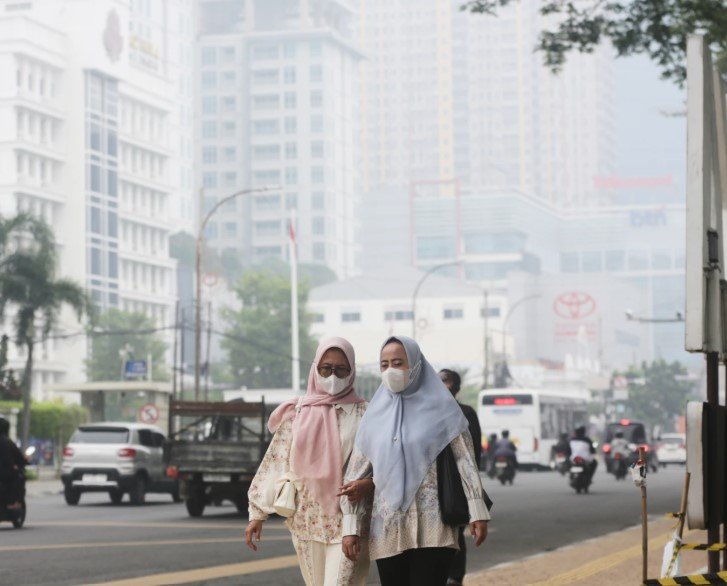
Smoke from forest and peatland fires has worsened air quality in parts of Malaysia, Singapore and Timor-Leste, raising concerns about respiratory illness and disrupting daily activities.
In a separate Reuters report, Singapore recorded a one-hour PM2.5 concentration of 284 micrograms per cubic metre in the western part of the country on Wednesday, 14 October.
The reading entered the country’s very high pollution category during the current haze episode.
PM2.5 refers to fine airborne particles that can penetrate deep into the lungs and pose health risks, particularly for children, older people, and those with existing respiratory conditions.
Timor-Leste also announced a three-day suspension of in-person classes beginning on 15 October because of pollution from fires in neighbouring areas.
Schools in parts of Malaysia have also closed because of deteriorating air quality.
Drought and peatland fires complicate the response
Indonesia’s prolonged dry season has made vegetation more vulnerable to fire, with El Niño-related conditions contributing to the severity of the emergency.
Land clearing using fire and the degradation of peatland ecosystems have added to the problem in some affected regions.
Peat fires are particularly difficult to extinguish because they can continue burning beneath the surface and reignite even after visible flames have been suppressed.
Indonesia’s Forestry Ministry reported 799 high-confidence satellite hotspots nationwide on Thursday evening, compared with 372 the previous day.
The ministry cautioned that these detections do not represent 799 separate fires, as a single blaze can produce multiple hotspots.
The continuing fires have increased pressure on emergency teams and complicated efforts to protect communities, transport routes, and wildlife.
Regional cooperation becomes increasingly important.
Indonesia’s immediate priorities are to contain the fires, protect affected communities, and coordinate the assistance now being considered.
The deaths at Mount Bromo have also drawn attention to the risks faced by firefighters and volunteers working in difficult conditions.
Beyond the current emergency, the scale of the crisis has renewed concerns about land management, peatland protection, and cooperation between Southeast Asian countries over cross-border air pollution.
For now, the arrival and deployment of foreign assistance remain important developments to watch as Indonesia continues its efforts to bring the fires under control.