Kenyan health authorities have quarantined 10 people following the country’s first confirmed imported Ebola case, involving a Kenyan citizen who travelled from the Democratic Republic of Congo through Uganda.
In an announcement dated 7 October, Kenya’s Ministry of Health said authorities had identified 57 contacts linked to the patient. Ten had been traced and placed under quarantine at the National Police Service Hospital in Nairobi, while follow-up work continued for the remaining contacts.
The 10 people are included in the total of 57. Being identified as a contact or placed under quarantine does not mean someone has tested positive.
Patient travelled through Uganda
According to Africa CDC, the patient travelled by road from Congo to Uganda, spent a night there and then flew to Kenya. The agency identified the infection as Bundibugyo Ebola virus disease and confirmed the patient’s death.
Africa CDC said it was sending a multidisciplinary team to support Kenya’s response and coordinating with authorities in neighbouring countries.
Questions over border screening
The patient’s journey has raised questions about how health surveillance operates across borders.
The Associated Press reported on 8 October that his symptoms were not detected during screening at Nairobi’s airport. Officials were investigating the journey with counterparts in Congo, Uganda, and Africa CDC.
Contact-tracing efforts include passengers and crew, aircraft cleaning staff, and officials who interacted with the patient.
Kenya strengthens preparedness
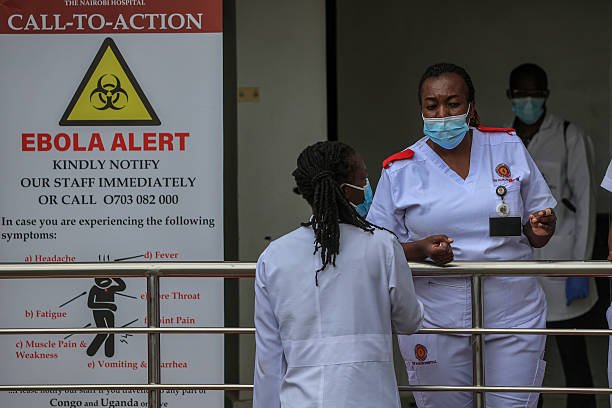
The health ministry said five facilities had been designated to manage suspected and confirmed cases. These include Kenyatta National Hospital, Moi Teaching and Referral Hospital, the National Police Service Hospital, Port Reitz Hospital, and Nairobi Hospital.
Authorities have also intensified screening at points of entry and urged travellers to provide accurate information on health declaration forms.
Health Cabinet Secretary Aden Duale said Kenya was not experiencing an Ebola outbreak following the single imported case. That assurance should be read alongside the continuing contact-tracing operation.
Why it matters to Africa and the diaspora
The case highlights the importance of neighbouring countries sharing information quickly when a patient travels across borders.
For diaspora families visiting the region, the practical priority is to follow official health and travel guidance. A traveller’s nationality or country of departure alone does not establish infection.
According to the World Health Organization, Ebola spreads through direct contact with infected bodily fluids or contaminated materials. Symptoms can develop between two and 21 days after infection.
Kenya’s health ministry advises anyone with symptoms or concerns about possible exposure to seek care promptly. Its toll-free health information number is 719.