
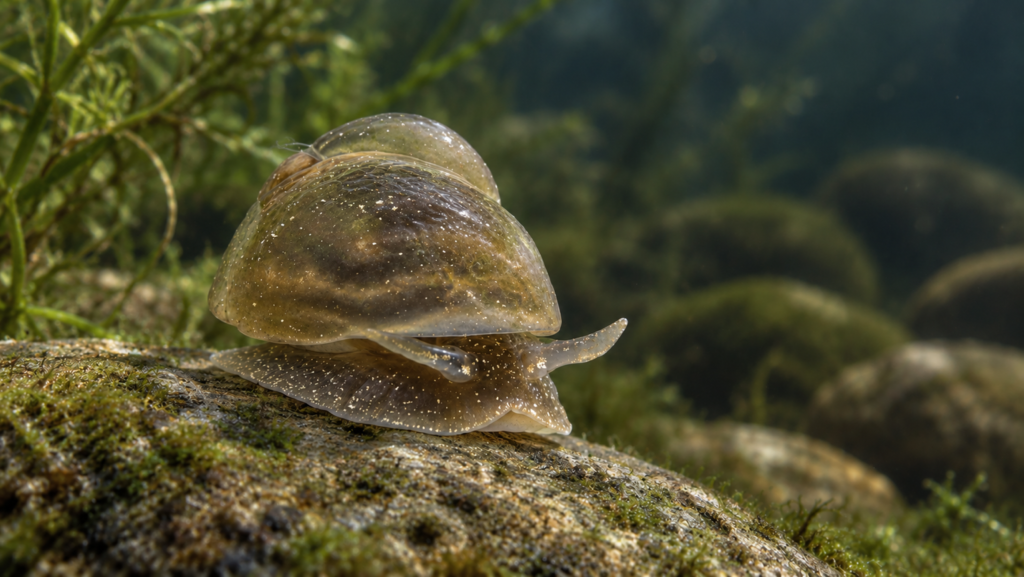
Scientists and conservationists are working to protect one of Europe’s rarest freshwater snails after its wild population in Britain became confined to a single lake in North Wales.
The glutinous snail, scientifically known as Myxas glutinosa, survives in the wild at Llyn Tegid, also called Bala Lake, in Eryri National Park. The lake is Wales’s largest natural body of water and is now considered the species’ final wild stronghold in Britain.
Conservation teams are breeding the snails in protected environments while studying what they need to survive. The long-term ambition is to strengthen the remaining population and potentially return the species to suitable freshwater habitats in England.
A small and unusual species
The glutinous snail measures less than 1.5 centimetres and has a thin, delicate shell. Its most distinctive feature is a translucent layer of tissue called a mantle, which can extend over the shell and give the animal a glass-like or gelatinous appearance.
This covering also makes the snail sticky to the touch, which explains its common name.
According to the Freshwater Habitats Trust, the species once lived in several parts of England, including Kent, Surrey, East Anglia, Cumbria and the Thames Valley.
Its last recorded English population was found near Oxford. The snail was observed there in 1988 but had disappeared by 1993. It was rediscovered at Llyn Tegid in 1998, and the Welsh population has been monitored since 2000.
Although captive populations are now being established elsewhere, Llyn Tegid remains the only known location in Britain where the species survives naturally in the wild.
Why the snail disappeared
The precise reasons for the glutinous snail’s decline are not fully understood, but poor water quality is considered one of the main threats.
The species appears to be particularly sensitive to pollution from farming, industry and other human activity. Its unusual mantle may allow it to absorb substances from the surrounding water more readily than some other freshwater snails.
Changes to aquatic vegetation and food supplies may also have contributed to the decline. The snail mainly feeds on thin layers of algae growing on stones and other surfaces. It cannot become dormant when food is scarce, making it especially dependent on stable environmental conditions.
Llyn Tegid may provide the right combination of clean water, wave movement, stones and algae required for the snail to survive. However, depending on one wild population leaves the species vulnerable to disease, pollution or sudden environmental change.
The glutinous snail is protected in the United Kingdom under the Wildlife and Countryside Act 1981. It is also classified as critically endangered on Britain’s national Red List.
Protected populations offer insurance
The British and Irish Association of Zoos and Aquariums says conservationists have created four new protected populations across its zoo community.
Institutions caring for the species include Askham Bryan Conservation and Wildlife Park, Dudley Zoo and Castle, Longleat Safari Park, Wingham Wildlife Park and Chester Zoo.
These protected groups are known as ark populations. They provide insurance against the loss of the remaining wild population and allow specialists to study breeding, diet and water conditions more closely.
A second group of snails has also been collected from Llyn Tegid under licence and with support from Natural Resources Wales. The animals are being kept in quarantine facilities as conservationists work to increase genetic and geographical protection for the species.
In 2024, Askham Bryan Wildlife Park received glutinous snails from Wales and placed them in a carefully managed, semi-natural pond. Staff said the transfer required particular care because of the animals’ extremely delicate shells.
Longleat later introduced the species to visitors through its Tiny Titans attraction, helping to bring public attention to an animal that would otherwise remain largely unknown.
Plans for recovery
A conservation action plan coordinated through BIAZA sets out measures to protect the surviving Welsh population, expand the captive breeding programme and identify suitable locations for possible reintroduction.
Returning the snail to England will require more than successful breeding. Conservationists must find habitats with consistently clean water, an adequate food supply and protection from pollution and disturbance.
The programme also highlights a wider environmental concern. Freshwater animals are often overlooked, but their decline can provide an early warning that lakes, rivers and ponds are deteriorating.
The rescue effort is therefore about more than preserving one unusual snail. Protecting the glutinous snail also means protecting the clean freshwater habitat on which many other species depend.