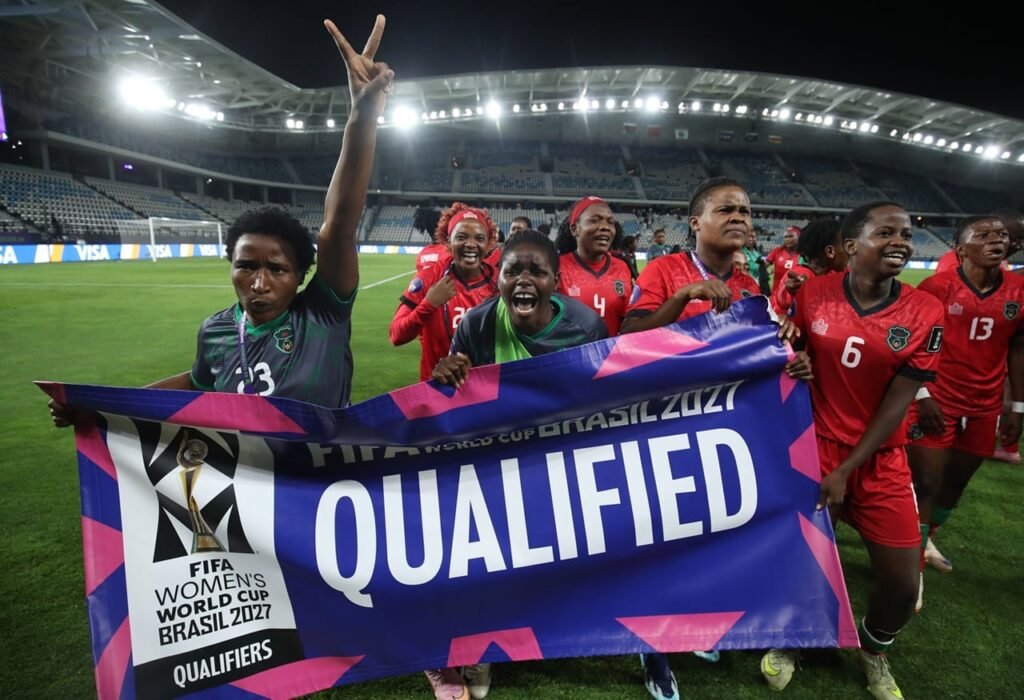
Algeria and Malawi will make their first appearances at the FIFA Women’s World Cup when the global tournament is staged in Brazil in 2027.
Both countries secured qualification through the 2026 Women’s Africa Cup of Nations in Morocco, where reaching the semi-finals guaranteed each team one of Africa’s four direct places at the World Cup.
Their qualification represents a significant expansion of Africa’s presence on the international stage and gives two emerging women’s national teams an opportunity to compete against the world’s leading sides.
Algeria make history after quarter-final comeback
Algeria confirmed their place at Brazil 2027 by defeating Côte d’Ivoire 2-1 in their WAFCON quarter-final on 8 August.
The Algerians recovered after falling behind, completing the comeback against a Côte d’Ivoire side reduced to 10 players. The result sent Algeria into the WAFCON semi-finals for the first time and secured the country’s first qualification for a senior FIFA Women’s World Cup.
The achievement followed years of uneven progress in the continental competition. Algeria first appeared at WAFCON in 2004 but had never advanced beyond the quarter-finals before the 2026 tournament.
Their campaign continued with a 3-1 semi-final defeat by Malawi. Algeria later recovered to defeat hosts Morocco on penalties in the third-place match, completing their best performance in the competition.
CAF confirmed Algeria’s historic World Cup qualification following the quarter-final victory.
Malawi’s remarkable debut campaign
Malawi’s route to the World Cup was one of the defining stories of the tournament.
The Scorchers were competing at WAFCON for the first time, but they advanced from the group stage before beating Ghana 2-1 in the quarter-finals. CAF’s official match record confirms that the victory secured Malawi’s place in both the semi-finals and the 2027 World Cup.
Malawi then defeated Algeria 3-1 to reach the WAFCON final on their tournament debut. Tabitha Chawinga scored twice in the semi-final, while her sister Temwa Chawinga added another goal.
The sisters were central to Malawi’s attacking success. Ahead of the final, they had scored nine of the team’s 12 goals at the tournament, according to CAF’s official final preview.
Malawi’s campaign ended with a 3-0 defeat by Cameroon in the final on 16 August. Despite the loss, reaching the final and qualifying for the World Cup marked an unprecedented achievement for the Scorchers.
CAF subsequently praised Malawi’s performance and formally recognised their qualification for Brazil 2027.
Africa’s four direct qualifiers confirmed
The question in FIFA’s post about which other countries would join Algeria and Malawi has already been settled.
Cameroon and Morocco are Africa’s other two direct qualifiers. All four teams reached the WAFCON semi-finals, the stage required to secure automatic qualification under the African qualifying format.
Cameroon won the continental championship after beating Malawi in the final, while Morocco finished fourth following their third-place playoff defeat by Algeria.
The four countries are listed in FIFA’s CAF qualification standings.
For Algeria and Malawi, the months leading to Brazil 2027 will bring a different challenge. Both teams must now build competitive squads, arrange strong international fixtures and prepare players for the greater pace and tactical demands of World Cup football.
Qualification has already delivered history. Their next task is to ensure that their first appearance on the global stage becomes the beginning of sustained progress rather than an isolated achievement.