
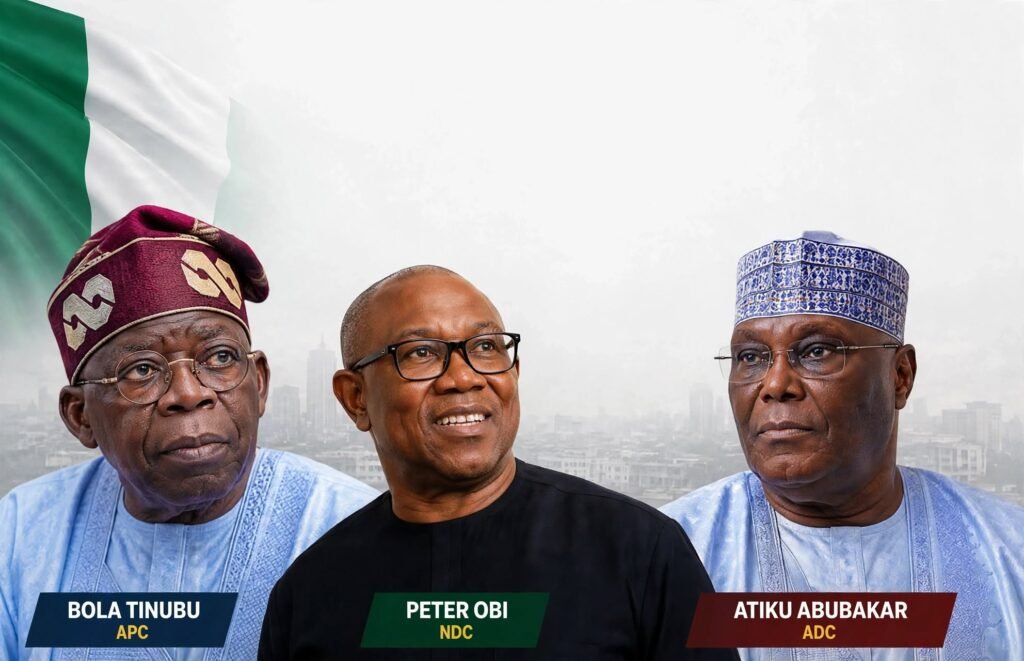
Nigeria’s 2027 presidential contest is taking shape, with President Bola Tinubu seeking a second term and opposition heavyweights Peter Obi and Atiku Abubakar preparing separate challenges.
The race is emerging at a difficult moment for Africa’s most populous country, where economic hardship, insecurity and public confidence in government are expected to dominate voter concerns.
For the ruling All Progressives Congress, the challenge is to defend its record after nearly 12 years in power. For the opposition, the central question is whether competing candidates can defeat an incumbent while fighting separately for many of the same dissatisfied voters.
Tinubu seeks a second term
President Tinubu secured the APC presidential nomination after entering the party’s primary as the clear favourite for the ticket.
Vice President Kashim Shettima had earlier submitted Tinubu’s nomination and expression-of-interest forms to APC officials in May, formally setting the president’s re-election bid in motion.
Tinubu will campaign on his administration’s economic reforms, infrastructure programme and claims of progress in stabilising government finances.
But those policies will also be central to the opposition’s case against him.
The removal of fuel subsidies, currency reforms and other economic measures have been welcomed by some investors but have also contributed to a severe cost-of-living squeeze for many households.
Insecurity remains another major issue, with kidnappings, armed violence and other security threats continuing in several parts of the country.
The election will therefore test whether voters believe the government’s reforms are beginning to deliver enough improvement to justify another four years.
Obi returns for another presidential contest
Peter Obi, who finished third in the 2023 presidential election, is again seeking the presidency.
He won the presidential nomination of the Nigeria Democratic Congress (NDC) after leaving an opposition alliance earlier in the year.
Obi continues to draw support from voters who backed his 2023 campaign, particularly younger Nigerians and sections of the urban electorate.
His decision to run separately, however, has revived one of the biggest strategic questions facing Tinubu’s opponents.
Can several major opposition candidates compete against the APC without dividing the anti-incumbent vote?
Atiku remains another major challenger
Former Vice President Atiku Abubakar is also contesting the presidency again, this time under the African Democratic Congress (ADC).
His candidacy gives the opposition another nationally recognised political figure with an established political network.
But the ADC faces a serious legal problem.
In June, a Federal High Court ordered INEC to deregister the ADC and four other political parties for failing to meet constitutional electoral performance requirements.
The ADC rejected the judgment and announced plans to appeal.
Until that legal process is resolved, uncertainty surrounding the party’s status remains an important part of the 2027 race.
INEC prepares for a high-stakes election
The Independent National Electoral Commission began the formal 2027 election process in February 2026 with the publication of its timetable and notice of election.
The process has not been entirely straightforward.
Federal High Court judgments in May questioned parts of INEC’s electoral timetable, including timelines relating to candidate nomination and substitution. INEC appealed the decisions, arguing that coordinated timelines are necessary to organise the election effectively.
The commission has also introduced updated regulations following changes contained in the Electoral Act 2026.
Beyond party nominations, attention will increasingly turn to the voters’ register, election technology, security and whether INEC can strengthen public confidence following controversies surrounding previous elections.
A fragmented opposition could shape the race
The presence of Tinubu, Obi and Atiku creates a familiar political problem.
A divided opposition does not automatically guarantee an APC victory, but it means candidates challenging the president may compete against one another for voters seeking an alternative to the government.
That makes regional voting patterns, turnout and coalition-building particularly important.
Nigeria’s 2023 presidential election recorded historically low participation, despite more than 93 million registered voters. Whether more Nigerians choose to participate in 2027 could significantly affect the outcome.
For the APC, incumbency brings organisational advantages but also responsibility for the country’s economic and security record.
For the opposition, dissatisfaction with the government creates an opportunity, but fragmentation could weaken its ability to convert that dissatisfaction into electoral victory.
The presidential race is therefore about more than the candidates themselves.
Between now and election day, Nigerians will be watching the economy, security situation, court cases involving political parties, INEC’s preparations and whether opposition alliances change.
Those developments may ultimately prove just as important as the names appearing on the ballot.
Facts first. Not frenzy.
Sources: INEC; State House; Reuters