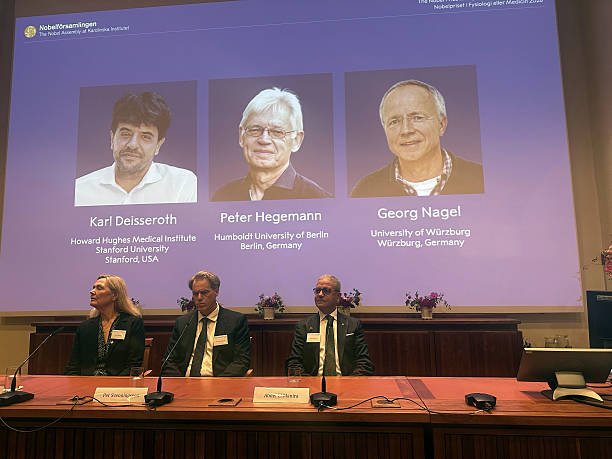
Karl Deisseroth, Peter Hegemann, and Georg Nagel have won the 2026 Nobel Prize in Physiology or Medicine for discoveries behind optogenetics, a method that allows scientists to control the activity of selected nerve cells using light.
The Nobel Assembly at Karolinska Institutet announced the award on Monday, 5 October. It recognised the three researchers for their work on light-gated ion channels and optogenetics.
How does it work?
The research began with a protein called channelrhodopsin, found in a single-celled alga. Hegemann and Nagel showed that the protein responds to blue light: it opens a channel that lets charged particles flow into a cell, creating an electrical signal.
Deisseroth later introduced the gene for the protein into nerve cells. By shining blue light on those cells, he could trigger a nerve signal. The method gave researchers a way to test what particular cells and circuits do in a living brain, rather than observing brain activity alone.
That distinction matters. Researchers can use optogenetics to examine how nerve circuits contribute to memory, behaviour, and other functions. The Nobel committee says the method has become an important tool for investigating the brain.
What could it mean for patients?
Scientists are studying whether light-sensitive proteins could help restore some sight to people with visual impairment. These are attempts to develop treatments, not proof that optogenetics is already a routine cure for blindness or other conditions. For now, its clearest established impact is as a research method.
The award recognizes a chain of discoveries: a light-responsive protein in algae, an understanding of how it changes a cell’s electrical activity, and a way to use it to investigate nerve cells. Together, those steps gave scientists a more precise means of exploring how the brain works.