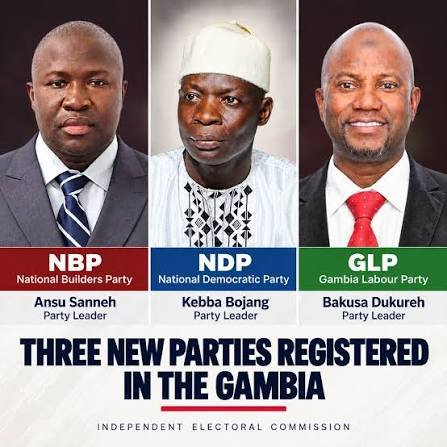
The Gambia’s Independent Electoral Commission has registered three new political parties ahead of the country’s presidential election scheduled for 5 December 2026.
The National Democratic Party, National Builders Party and Gambia Labour Party were approved after meeting the registration requirements under the Elections Act 2025.
Their registration brings the number of recognised political parties in The Gambia to 27, according to the commission.
The development expands an already crowded political field less than three months before the election. However, registration as a political party does not automatically place its leader on the presidential ballot.
Prospective candidates must complete a separate nomination process, including providing the required voter signatures and supporting documents. The commission is expected to receive presidential nominations before the official campaign period begins.
Three parties enter the political field
The National Democratic Party is led by Kebba Madi Bojang, a former National People’s Party official who previously served as the ruling party’s national youth president.
Bojang became a critic of the NPP following disagreements over its leadership and treatment of party supporters. He and three other officials were later removed from their positions.
The NDP initially operated without formal registration and received warnings from the electoral commission over its early use of party symbols. Its approval now gives Bojang and his supporters a recognised political platform from which to organise ahead of the election.
Bojang has rejected the possibility of returning to the NPP, arguing that such a decision would betray the confidence placed in him by his supporters.
The National Builders Party is led by Ansu Sanneh. The party presents itself as a policy-focused organisation with proposals covering healthcare, education, infrastructure, agriculture, governance, public safety, taxation and the wider economy.
Its programme, known as “Operation Build the Nation”, is intended to explain the party’s priorities, how its proposed policies would be financed and which institutions would be responsible for delivering them.
The third party, the Gambia Labour Party, is led by Bakusa Dukureh, who has spent a significant part of his professional life in the United States.
Dukureh has said he intends to contest the presidential election and has presented the GLP as a platform for Gambians seeking political and institutional change.
Details about the three parties and their leaders were reported by The Gambia Journal, citing the electoral commission’s announcement of 17 September.
Established parties prepare for the election
The new parties are entering a contest that is expected to include several established political figures.
President Adama Barrow is seeking another term under the National People’s Party. His expected candidacy comes as his administration faces public concern over electricity shortages, the cost of living and the pace of political reform.
Ousainou Darboe’s United Democratic Party is also preparing for the election, while Talib Bensouda is expected to lead the newly registered Unite for Nation Integrity, Transformation and Equality, commonly known as UNITE.
The electoral commission registered UNITE and the All Inclusive Party in July, increasing the number of newer political organisations seeking space alongside the country’s longer-established parties.
The final list of presidential candidates will not be settled until the nomination process has been completed and the commission has determined that each candidate meets the legal requirements.
New parties face organisational test
Formal registration is only the first stage for the three parties. They must now build effective structures, recruit supporters and establish a visible presence across the country before voting begins.
New political movements may struggle to compete with established parties that already have recognised leaders, experienced campaign organisations and support networks in different regions.
A larger number of parties could give voters more political choices, but it may also divide opposition support and encourage alliances before the election.
The new parties will need to demonstrate that they can move beyond their leaders’ profiles and present credible national programmes to voters.
The 5 December election will determine whether President Barrow remains in office or whether one of the established or emerging opposition movements can secure enough support to replace him.