
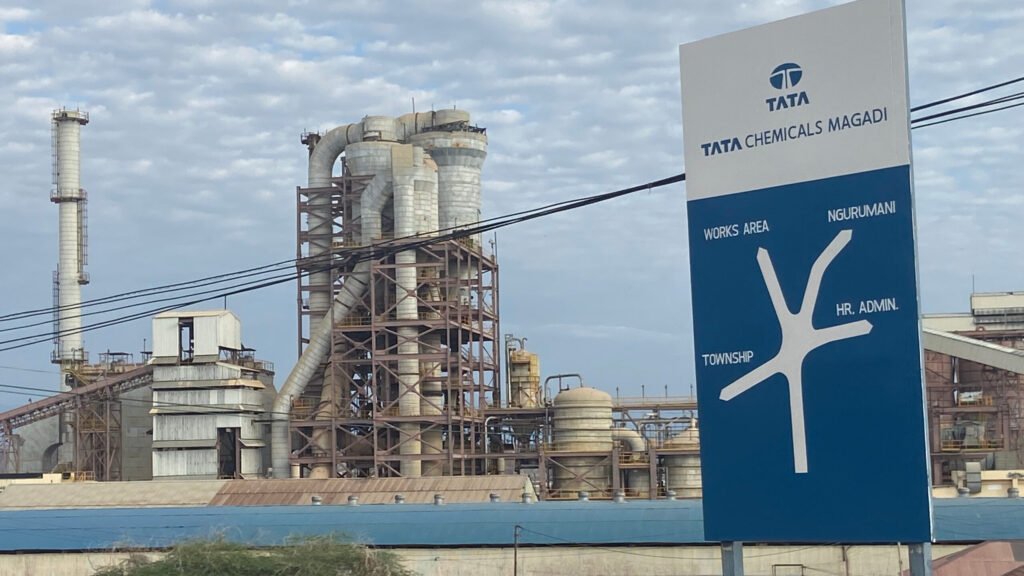
Kenyan President William Ruto says he has ordered Tata Chemicals to end its operations in the country, escalating a long-running dispute over the company’s soda ash business at Lake Magadi.
Speaking during a visit to Kajiado County on Thursday, 3 September, Ruto criticised the company for exporting soda ash without developing enough manufacturing capacity in the area where the mineral is extracted.
He said the government intends to bring in new investors, including companies expected to establish glass and chemical manufacturing facilities in Kajiado.
The announcement comes just over a month after Kenya’s Ministry of Mining suspended Tata Chemicals Magadi’s mining operations and soda ash exports over alleged failures to meet regulatory requirements.
Tata has disputed claims that it is non-compliant and said in August that it had submitted the documents requested by the government and was waiting for further direction.
A business stretching back more than a century
Commercial soda ash production at Lake Magadi dates to 1911.
Tata Chemicals became involved much later, acquiring the operation through its purchase of British chemical company Brunner Mond in 2005.
The Kenyan operation has since become a significant part of the country’s mineral export industry.
Tata Chemicals says its Magadi business exports more than 350,000 tonnes of natural soda ash annually to markets in Africa, India, Southeast Asia and the Middle East.
Soda ash, also known as sodium carbonate, is an industrial material used in products including glass, detergents and other chemicals.
Ruto’s criticism centres partly on what happens to that resource after it is extracted.
He argued that Kenya should receive greater value from the minerals produced in Kajiado rather than relying heavily on exports of soda ash.
Government raised several compliance concerns
The confrontation did not begin with Thursday’s announcement.
On 28 July, Kenya’s Ministry of Mining directed Tata Chemicals Magadi to suspend mining operations. Soda ash exports were also stopped.
Mining Cabinet Secretary Hassan Joho said the decision followed years of engagement with the company over its obligations under Kenyan mining laws.
The ministry identified several alleged shortcomings, including royalty reconciliation and payments, export reporting, environmental compliance, community development agreements, employment and skills transfer for Kenyan workers and procurement of local goods and services.
It also raised concerns about the company’s strategy for processing minerals and adding value locally.
The ministry said operations could resume after Tata provided evidence that it had met its statutory obligations and addressed outstanding liabilities.
Tata says it complied with government’s demands
Tata Chemicals has presented a different account of the dispute.
In a statement on 17 August, the company said it had submitted all the information, reports and documents requested by the Mining Ministry.
It said it had responded comprehensively to the government’s concerns and demonstrated compliance with applicable regulations.
The company said its operations had remained suspended since 28 July while it waited for the ministry to review its submission.
Tata also warned that a prolonged shutdown was creating uncertainty for workers, contractors, suppliers and businesses connected to the operation.
It said about 500 employees and their families were affected directly, while approximately 30,000 people in the Magadi community benefited from company-supported programmes involving water, healthcare, education and infrastructure. Those figures are Tata’s own estimates.
Reuters reported on Thursday that the company could not immediately be reached for comment on Ruto’s latest remarks.
Ruto wants more processing inside Kenya
The dispute now goes beyond regulatory compliance.
Ruto says his government wants future investors to process more of the resource inside Kenya.
He said new companies brought into Kajiado should establish facilities producing glass and chemicals rather than simply extracting resources for export.
That approach reflects a wider debate across mineral-producing African economies about value addition.
Governments increasingly want natural resources processed domestically so that more manufacturing, skills development and employment remain within their economies.
But replacing an established operator also raises practical questions.
The government will need to clarify the legal process for ending Tata’s operations, the future of existing workers, how new investors will be selected and how quickly production could resume under a different operator.
Those details were not fully established in the information available on Thursday.
Trivane View: The bigger issue is what Kenya gains from its minerals
The dispute at Lake Magadi is bigger than one company.
Kenya has a legitimate interest in ensuring that natural resources create jobs, local industries and meaningful benefits for surrounding communities.
But achieving that requires more than changing operators.
If new investors eventually replace Tata Chemicals, the real test will be whether Kenya secures stronger local processing, transparent investment terms, environmental protection and sustainable employment without creating unnecessary uncertainty around legitimate investment.
The outcome at Lake Magadi could therefore become an important test of how Kenya balances foreign investment with its push to retain more value from its natural resources.
Source: Reuters, 3 September 2026.
Facts first. Not frenzy.