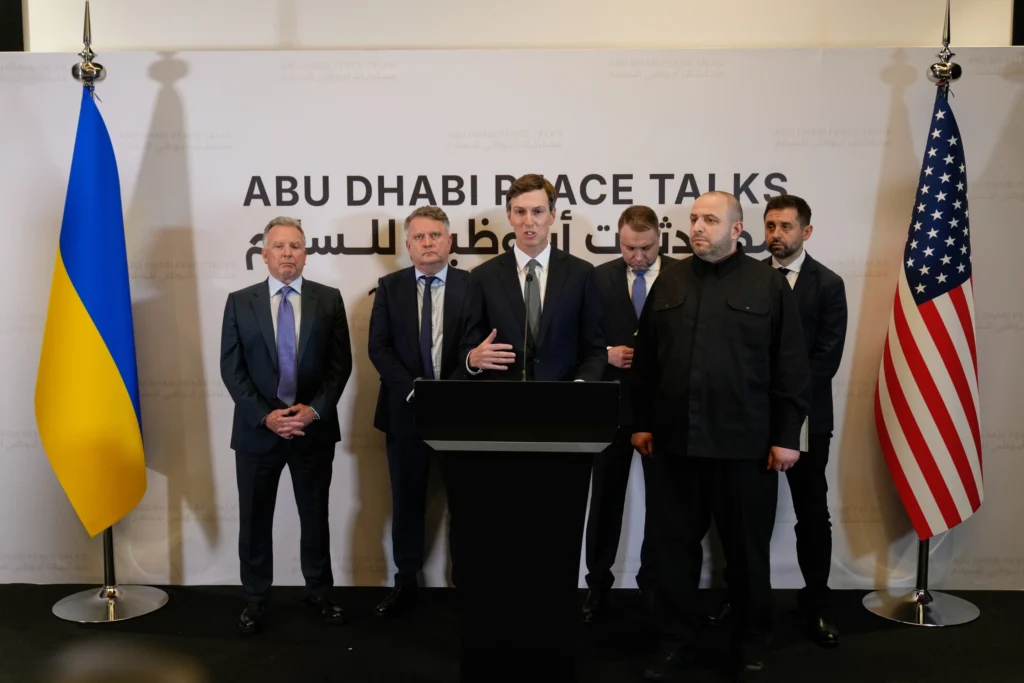
Russia and Ukraine agreed in principle to arrange a large prisoner-of-war exchange after their delegations concluded two days of talks mediated by the United States in Abu Dhabi on Wednesday, 11 November 2026. The announcement was the clearest tangible result of a diplomatic effort that did not produce a ceasefire or resolve disputes over occupied territory. According to Associated Press, the number of captives expected to return home remains unsettled. US envoy Jared Kushner said negotiators intended to finalise the total on Thursday. A commitment to organise an exchange should not be reported as a completed release: no confirmed implementation date, final list of names, or transfer arrangements were announced at the conclusion of the meeting.

Why Is the Prisoner Exchange Significant?
Prisoner exchanges can provide direct humanitarian relief to families, even when governments remain deeply divided over the causes and terms of a war. A large operation requires both sides to reconcile records of those held, verify identities, arrange safe transfer points, and resolve disagreements over particular detainees. Russia and Ukraine have undertaken earlier exchanges, so this agreement represents the continuation of a practical diplomatic channel rather than proof that the wider conflict is approaching an end. For families awaiting news of missing relatives, an announcement may bring hope, but only actual reunions will establish that the latest commitment has been fulfilled. The ultimate scale of the exchange should be assessed against official lists and independently corroborated handovers.
What Prevented a Wider Peace Agreement?
The delegations remain far apart on Russian demands concerning Ukrainian territory and the nature of security arrangements after any eventual ceasefire. Kyiv insists that its sovereignty and future protection cannot be decided without its consent. Moscow has pressed for guarantees of its own and has questioned the role European governments should have in negotiating a future settlement. According to Reuters, Russia’s lead negotiator Vladimir Medinsky said there had been understanding on some issues and disagreement on others. His assessment suggests that discussions may continue but does not amount to acceptance of a common peace plan. Statements about progress must therefore be weighed against the absence of a signed settlement or a verified cessation of hostilities.
Where Do European Governments Fit In?
European states are central to questions about security guarantees, reconstruction financing, sanctions, and the defence arrangements that might follow a settlement. Yet the format of these negotiations remains contested. Ukrainian officials argue that European partners must participate in decisions affecting the continent’s security, while Moscow has been more sceptical of their involvement. Euronews reported that the US and Ukrainian sides held discussions with European representatives alongside the talks in the UAE. That contact is not the same as European governments becoming formal parties to the direct Russia–Ukraine negotiations. Any durable framework will need to establish who provides guarantees, how commitments are enforced, and which bodies can investigate suspected violations.
What Happens After the Talks?
Kushner and fellow US envoy Steve Witkoff are expected to brief Russian President Vladimir Putin in Moscow and then meet Ukrainian President Volodymyr Zelenskyy in Dublin. These scheduled contacts could clarify whether the parties have room to negotiate over the toughest disputes. However, a proposed visit should not be presented as evidence of a forthcoming summit or an agreed timetable to end the fighting. Attention should also remain on the prisoner-exchange arrangements, including whether the parties publicly confirm numbers, dates, and a mechanism for the transfers. Without those details, the humanitarian pledge remains an important but incomplete step.
Why Does the Outcome Matter Beyond Ukraine?
The war continues to affect European security, trade routes, energy infrastructure, and humanitarian budgets. Continued attacks on civilians and essential services can undermine confidence even when negotiating teams issue positive statements. African countries may also experience indirect pressures from global energy prices, food trade, and development spending. The implications will depend on actual market movements and policies rather than on speculation about the talks. The immediate editorial task is to keep the difference between an agreement in principle, a practical prisoner release, and a wider peace accord clear to readers.
How Should the Diplomatic Claims Be Judged?
Negotiators frequently describe difficult meetings as constructive because preserving dialogue may be useful even when compromise is limited. Such language is not a measurable agreement. Newsrooms should look for signed documents, acknowledged points of disagreement, independent monitoring arrangements, and concrete steps that can be confirmed outside diplomatic briefings. The prisoner exchange provides a near-term test: numbers must be finalised, captives identified, and exchanges carried out safely. Until that happens, claims about the size of the operation remain provisional. Reporting should also recognise that negotiations do not suspend the parties’ responsibilities to protect civilians and comply with international humanitarian law.
Trivane View
A humanitarian agreement deserves recognition without being mistaken for a political breakthrough. The parties should make verifiable prisoner-transfer arrangements public while continuing negotiations that protect civilians and respect international law.
Related Trivane News
Russian Strikes Damage Kyiv Bridge and Energy Network Ahead of Peace Talks
G7 Ministers Meet in Paris as Ukraine Peace Talks and Iran Crisis Test Unity