
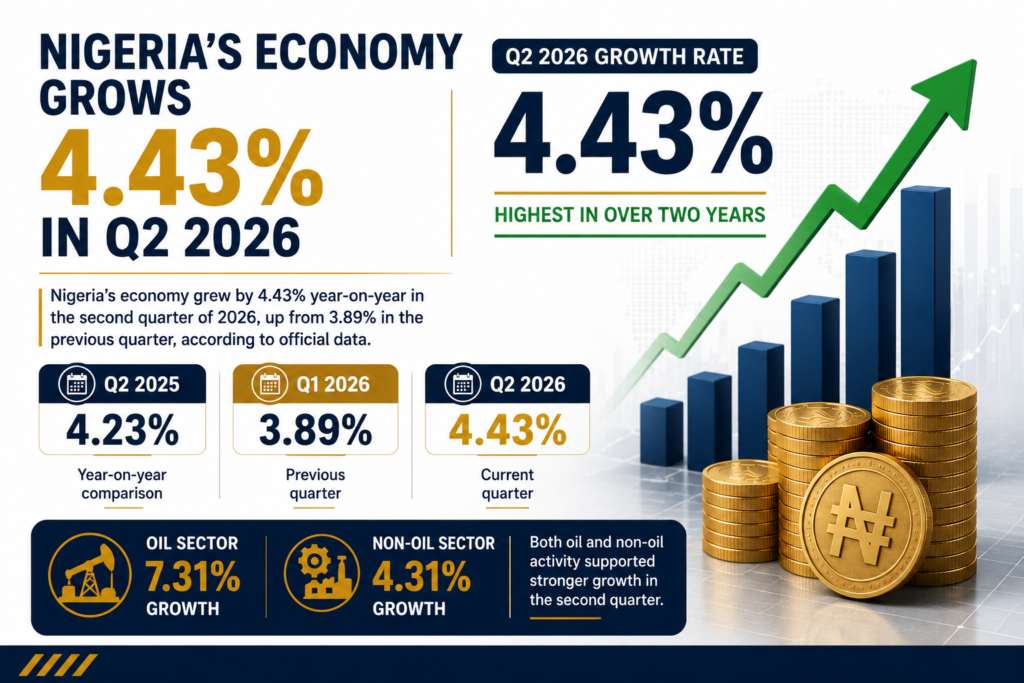
Nigeria’s economy grew by 4.43% year-on-year in the second quarter of 2026, its strongest quarterly growth rate in more than two years, according to figures from the National Bureau of Statistics.
The result marks an improvement from 3.89% in the first quarter of 2026 and 4.23% in the second quarter of 2025.
Both the oil and non-oil sectors recorded stronger growth, giving Nigeria a more positive economic reading as the country continues to deal with pressure on household finances.
The economy grew by 3.87% in real terms in 2025, compared with 3.38% in 2024, according to figures cited by Reuters.
Oil sector strengthens
Nigeria’s oil sector grew by 7.31% year-on-year in the second quarter.
That was a sharp improvement from the 2.57% growth recorded in the first quarter of 2026, although it remained below the 20.46% recorded in the same quarter last year.
Higher crude oil production helped the sector.
Average daily production increased to 1.72 million barrels per day, compared with 1.55 million barrels per day in the first quarter and 1.68 million barrels per day in the second quarter of 2025.
Despite its importance to government revenue and foreign exchange, oil accounted for only 4.16% of real GDP during the quarter.
Non-oil economy remains the bigger engine
The non-oil economy continued to account for the overwhelming majority of Nigeria’s economic activity.
It grew by 4.31% in the second quarter, compared with 3.94% in the previous quarter and 3.64% in the same period last year.
The sector contributed 95.84% of real GDP.
Agriculture, information and communication, real estate, trade, financial and insurance services, manufacturing and construction were among the activities supporting non-oil growth.
Services remained Nigeria’s largest broad sector, contributing 56.62% of real GDP, while agriculture accounted for 26.15%.
The figures show why Nigeria’s economic story can no longer be measured by crude oil performance alone.
Growth is improving, but challenges remain
The 4.43% result gives the government another sign that economic activity is strengthening.
But Nigeria still faces a difficult task in turning economic expansion into improvements that households can see and feel.
Reuters noted that the latest growth rate remains below President Bola Tinubu’s ambition of achieving annual economic growth of around 7% by 2027.
Reaching higher and sustained growth would be particularly important for a country with a large population, major infrastructure needs and millions of young people seeking economic opportunities.
One strong quarter alone will not resolve those pressures.
The Trivane angle: are Nigerians feeling the growth?
GDP measures the value of goods and services produced in an economy. It does not automatically tell us whether families are becoming financially better off.
That distinction matters in Nigeria.
An economy can grow while households continue to struggle with food, transport, housing and other everyday expenses.
For Nigerians at home, and members of the diaspora who regularly support relatives, the more meaningful test may be whether stronger economic performance eventually produces better jobs, higher real incomes and greater purchasing power.
That is why the 4.43% headline matters, but cannot tell the whole story.
What comes next
Nigeria enters the second half of 2026 with stronger economic momentum than it had at the beginning of the year.
Oil production has improved, but the latest figures also underline the importance of the non-oil economy, which generates more than 95% of real GDP.
Sustaining the improvement will require continued growth across agriculture, services, manufacturing and other productive sectors.
For policymakers, the latest numbers provide evidence that economic output is moving in the right direction.
For households, the standard will be more practical.
Economic growth becomes more meaningful when stronger national figures are reflected in jobs, incomes and the everyday cost of living.
Source: Reuters, 31 August 2026 – Nigeria’s economy expands by 4.4% in Q2, lifted by oil and non-oil sectors. Read the Reuters report
Facts first. Not frenzy.