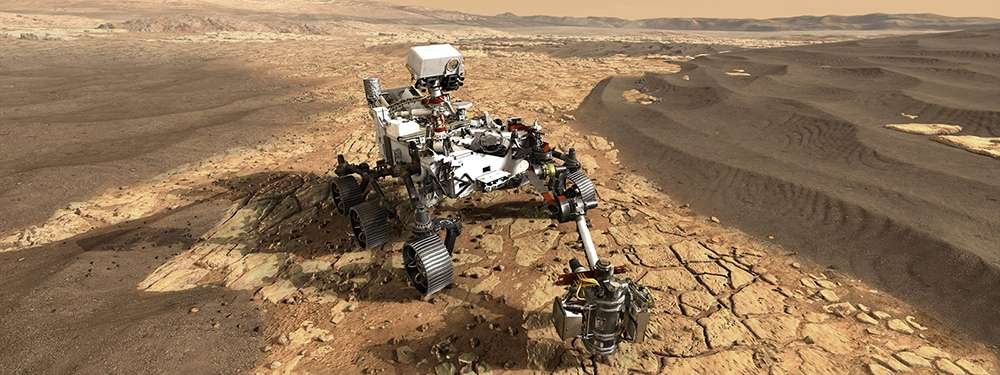
NASA’s Perseverance rover has set a new record for the greatest distance driven by a vehicle on another world, travelling 45.22 kilometres (28.10 miles) across Mars since landing in February 2021.
NASA announced on Monday, 12 October 2026, that the six-wheeled rover had passed the previous mark of 45.16 kilometres (28.06 miles) set by Opportunity. Perseverance achieved the record on 11 October, its 2,006th Martian day, or sol.
The milestone took Perseverance about five and a half years, compared with almost 15 years for Opportunity, which explored Mars between 2004 and 2018.
A Record Beyond Jezero Crater
Perseverance broke the record while travelling through Lac de Charmes, beyond the western rim of Jezero Crater, towards an area known as Idubi. Scientists are examining ancient rocks there for evidence of geological processes that may once have supported habitable environments.
Reuters reported on 13 October that the rover remains in strong operating condition as its team plans further exploration. NASA has extended the mission to continue investigating the crater rim until approximately the end of 2028.
How Autonomous Driving Helped
A major reason for the rover’s progress is its AutoNav system, which allows it to examine terrain, build a three-dimensional map of obstacles, and choose a safe route between points selected by controllers on Earth.
NASA says Perseverance has used autonomous navigation for more than 90% of the distance it has driven. Its software can assess hazards while the rover moves, reducing the need to wait for detailed instructions from Earth at every stage.
The record concerns total distance travelled, not the length of a single drive. NASA says the rover has covered as much as 412 metres in one Martian day.
Searching for Signs of Ancient Life
Perseverance landed in Jezero Crater in February 2021 to study whether ancient Martian environments could have supported microbial life. The crater once contained a lake and river system, making its rocks valuable records of Mars’s wetter past.
According to NASA Science, the rover has collected 29 rock and regolith samples from the crater floor, ancient delta and crater rim. Those samples could help researchers examine the planet’s history if a future mission returns them to Earth.
The rover has also investigated a rock called Cheyava Falls, containing features NASA describes as potential biosignatures. That does not establish that life existed on Mars; further analysis is needed.

What Comes Next
NASA plans to use the extended mission to explore more ancient terrain, including locations where water may once have circulated through hot rock. Longer autonomous drives could allow the rover to reach more geological sites while its instruments remain operational.
The new distance record is therefore more than a measure of endurance. It demonstrates how robotic navigation can expand the range of scientific exploration on another planet.