
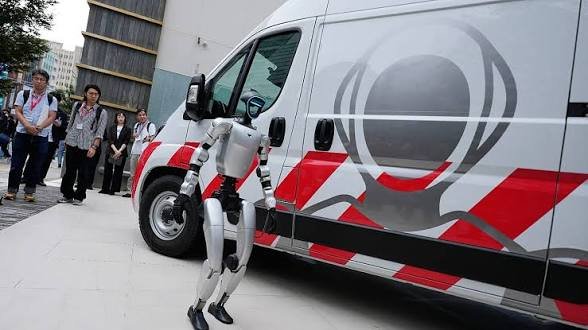
A Japanese technology company has introduced a mobile maintenance vehicle designed to repair humanoid robots when they break down at workplaces.
GMO AI & Robotics Corporation, known as GMO AIR, unveiled the vehicle in Tokyo on September 8. The company has named it the “GMO Humanoid Ambulance.”
Despite its name and ambulance-style appearance, the vehicle is not designed for medical emergencies. It is a mobile workshop that carries human engineers, diagnostic equipment, repair tools, spare parts and a replacement humanoid robot.
The service is expected to begin operating in Tokyo during September 2026.
How the service works
When a humanoid robot develops a fault, the vehicle can transport an engineer and the necessary equipment to its location.
The engineer will examine the robot and attempt to repair it on site. If the fault cannot be fixed immediately, the damaged robot can be replaced temporarily with another unit carried inside the vehicle.
The faulty machine will then be transported to a specialist repair centre, including the GMO Humanoid Lab in Shibuya, where more detailed work can be completed.
According to GMO AIR’s official announcement, the system is intended to reduce the amount of time a robot remains unavailable after a breakdown.
The company said it developed the service after experiencing delays when damaged humanoid robots had to be removed from their operating sites and sent elsewhere for repairs.
One vehicle operating initially
Only one maintenance vehicle is currently based at GMO’s headquarters in Tokyo.
The company could introduce more vehicles and repair bases if demand increases. For now, the service will mainly support humanoid robots supplied or introduced by GMO AIR.
The company will decide whether to dispatch the vehicle according to the condition of the robot and the availability of its maintenance team.
GMO AIR describes the vehicle as Japan’s first maintenance unit designed specifically for humanoid robots. However, that claim is based on the company’s own research and has not been independently established as a national record.
Euronews, reporting with the Associated Press, said the vehicle has space for computers, maintenance equipment, replacement components and humanoid machines.
The repairs will be carried out by trained engineers. The vehicle is not autonomous, and robots will not repair themselves.
Preparing for wider robot use
GMO AIR believes maintenance services will become increasingly important as humanoid robots move beyond laboratories and begin working in factories, offices, shops and other commercial environments.
A robot breakdown could interrupt business operations, particularly where a machine has been assigned a regular task. Delivering repairs and replacement units directly to the workplace could help companies limit that disruption.
GMO AIR was established in 2024 to support the introduction and operation of artificial intelligence systems, robots and drones. Its services include humanoid robot sales, rentals, development and maintenance.
The wider market for advanced robots is also expected to grow. A McKinsey analysis estimated that the global market for general-purpose robotics could reach about $370 billion by 2040 under its central projection.
Such forecasts remain uncertain because humanoid robots are still expensive, technically complex and not widely deployed.
The GMO vehicle does not demonstrate that humanoid robots are already operating on a large scale. Instead, it represents an early attempt to build the maintenance system that companies may require if workplace use expands.
Its success will depend on demand for humanoid robots and whether businesses consider a dedicated mobile repair service practical and affordable.