French government borrowing costs rose sharply on Wednesday, October 21, as investors assessed the impact of widespread protests, political uncertainty, and the government’s struggle to strengthen public finances.
The yield on France’s benchmark 10-year government bond reached 5% for the first time since July 2002, according to “Reuters”
Bond yields represent the return investors demand for lending money to a government. When yields rise, a government generally faces higher costs when issuing new debt or refinancing maturing borrowing.
The increase in French yields also contributed to a broader rise in eurozone borrowing costs, with investors demanding higher returns amid concerns about the region’s economic and political outlook.
Political Unrest Adds to Financial Pressure
France has experienced widespread protests that have placed additional pressure on a government already struggling to secure a budget and reduce its deficit.
Although unrest had eased somewhat by Tuesday, further demonstrations were planned for Saturday, adding to uncertainty over the country’s economic outlook.
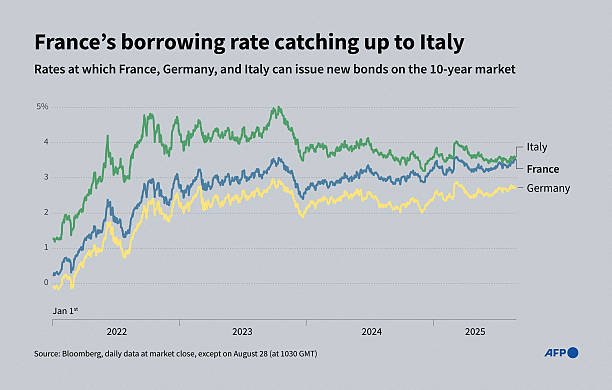
Reuters reported that French 10 year bond yields had risen by more than 20 basis points during the week, compared with an average increase of approximately 5.7 basis points across bonds issued by the world’s largest economies.
One basis point is equal to 0.01 percentage points. A rise of 20 basis points, therefore, represents an increase of 0.20 percentage points.
The pressure has also affected businesses. Carrefour, Europe’s largest food retailer, reduced its operating-profit-margin growth targets after disruptions associated with the unrest.
ING rates strategist Benjamin Schroeder told Reuters that the protests were adding to concerns about France’s ability to improve its public finances and were also creating direct economic cosss through lost output.
France Pays More to Borrow Than Germany
The difference between French and German 10 year government bond yields widened to around 150 basis points, reflecting the additional return investors demand to lend to France rather than Germany.
Germany’s government bonds are commonly used as a benchmark for eurozone borrowing costs because they are generally regarded as a lower risk investment.
A widening gap between French and German yields suggests investors perceive greater risk in lending to France relative to Germany.
France’s 10 year yield was reported at 5% in Reuters’ updated market report, while Germany’s equivalent yield stood at approximately 3.43%.
The difference increases the financial pressure on France as it attempts to manage its debt and bring its budget deficit under control.

Wider Economic Implications
Higher government borrowing costs can make it more expensive for a country to refinance debt and finance new spending. Over time, that can leave less room in the budget for public services, infrastructure, and other priorities.
The effects are not necessarily immediate, because existing government debt is not all refinanced at once. The longer-term impact depends on how long yields remain elevated, the maturity of the debt, and the government’s future borrowing needs.
Investors are also monitoring Italy, where protests linked to the cost of living have prompted the government to announce tougher anti-rioting measures. However, Italian borrowing costs have risen less sharply than those of France during the week.
Meanwhile, a rebound in crude oil prices above $110 a barrel added to negative sentiment across European bond markets.
Government Faces Budget Challenge
The French government is attempting to advance a budget through parliament while working to reduce a substantial deficit ahead of next year’s elections.
The combination of political instability, public demonstrations, and rising borrowing costs complicates that effort. If yields remain high, the government could face greater costs when issuing new debt, adding another challenge to its fiscal plans.
For now, the rise in French bond yields reflects investor concerns rather than a declaration that the country cannot meet its financial obligations. The direction of borrowing costs will depend on developments in the political situation, the government’s budget plans, and investor confidence.