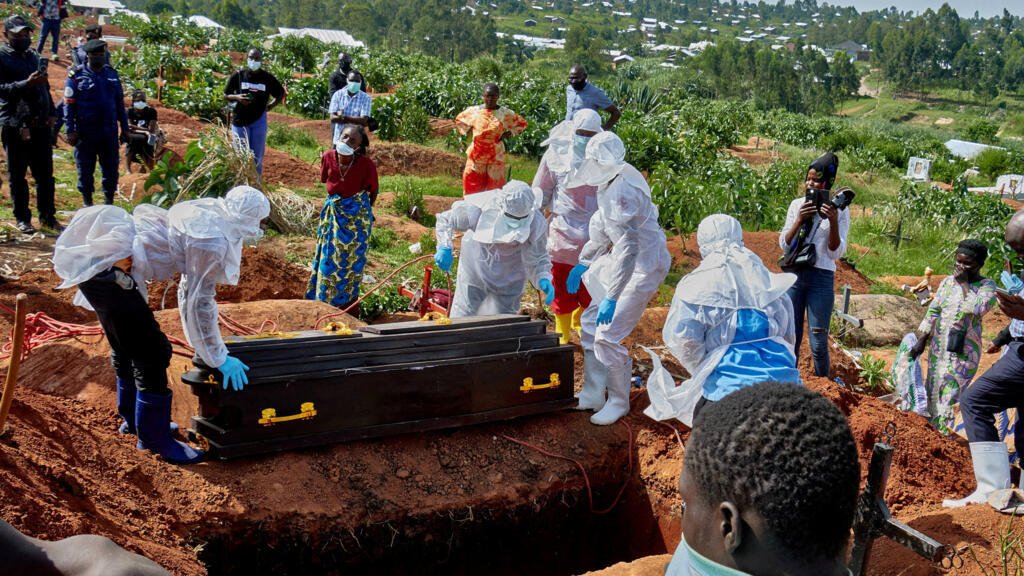
Renewed clashes in Djugu territory, in the eastern Democratic Republic of Congo (DR Congo), are disrupting efforts to contain the Ebola outbreak in Ituri Province, with health workers facing increasing difficulties reaching affected communities.
The fighting has forced residents to flee their homes, including people infected with Ebola and individuals identified as contacts requiring medical monitoring. Their displacement is complicating efforts to track possible infections and maintain the continuity of treatment and surveillance activities.
In a report published on Wednesday, November 25, “Radio Okapi” said the population movements were affecting the Nizi health zone, with some displaced residents arriving in Bunia and Rwampara, where new positive cases were reportedly being recorded daily.

Insecurity obstructs health operations
The renewed violence has also restricted access for humanitarian and medical teams working in affected communities.
Activities disrupted include public awareness campaigns, safe and dignified burials, and the decontamination of locations where Ebola infections have been reported, including Bambou, Lita, Kilo and Mangala.
The situation in Mangala has raised particular concern. A treatment centre scheduled to officially open on Wednesday was reportedly facing difficulties, with patients and people identified as contacts being accommodated in the same room because of limited space.
The World Health Organization has warned that insecurity is undermining the response. In a statement issued on November 22, the organisation reported violent clashes near a hospital in Ituri and said it was working with humanitarian partners and parties to the conflict to arrange the safe evacuation of its team.
The WHO also called for immediate safe passage for its personnel and the protection of hospitals, healthcare workers and patients.
Renewed violence drives displacement
The latest disruption follows renewed clashes between the Congolese armed forces and the Convention for the Popular Revolution (CRP), a militia operating in parts of Ituri.
“Radio Okapi reported on November 24″ that at least 10 people had been killed in fighting around Iga-Barrière, Lindji and Lopa, north of Bunia. The provisional toll, attributed to security sources, included seven militia members and three civilians.
The clashes have prompted residents from surrounding communities to flee towards Bunia, the provincial capital, adding to the humanitarian pressures in the region.
The Ebola response is particularly vulnerable to such movements because identifying and monitoring people who may have been exposed to the virus depends on reliable access to affected communities and consistent follow-up.
A growing challenge for containment efforts
The WHO has called on parties to the conflict to ensure safe access for humanitarian workers and protect medical facilities from the effects of the fighting.
The latest developments highlight the difficulties of controlling an infectious disease outbreak in an area where insecurity, population displacement and limited access to healthcare continue to affect emergency operations.
Trivane View
The fighting in Ituri demonstrates how conflict can weaken public-health responses and place vulnerable communities at greater risk. Protecting medical teams, patients and healthcare facilities must remain a priority, as the disruption of disease surveillance and treatment could make an already serious outbreak harder to contain.