Ethiopia is facing growing security and diplomatic pressures as renewed fighting in its northern Tigray region coincides with deteriorating relations with Eritrea and unresolved disputes over access to the Red Sea and the Nile River.
The tensions have raised concerns that domestic conflict could spread beyond Ethiopia’s borders, threatening stability across the Horn of Africa.
According to an Associated Press report published on 19 October, the overlapping disputes have created a dangerous regional situation involving armed groups, neighbouring governments and competing interests over territory and natural resources.
Prime Minister Abiy Ahmed’s government faces the challenge of containing renewed violence while managing increasingly strained relationships with other countries.
Renewed fighting threatens Tigray’s fragile peace
Tigray was the centre of a devastating war between Ethiopian federal forces and Tigrayan fighters from November 2020 until a peace agreement was signed in November 2022.
The conflict caused widespread deaths, displacement, and destruction, leaving communities struggling to recover.
However, renewed fighting has seriously undermined the settlement.
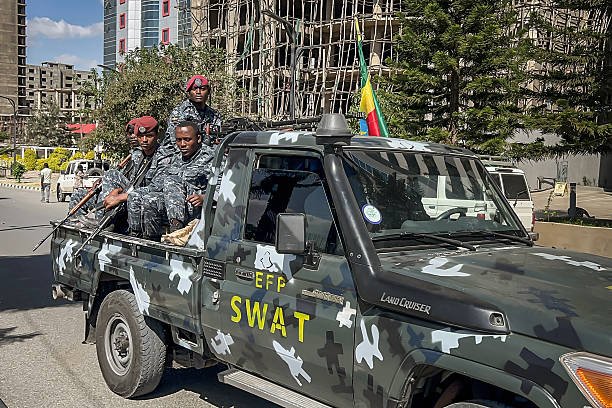
Government-aligned forces entered Tigray’s capital, Mekelle, on 4 October 2026, prompting forces associated with the Tigray People’s Liberation Front (TPLF) to withdraw from the city.
Ethiopia subsequently established a six-month caretaker administration intended to restore public services, assist displaced residents, and prepare for regional elections.
The developments have not ended the wider conflict.
The TPLF remains part of a broader challenge to the federal government, while divisions among Tigrayan political and armed groups have complicated efforts to establish lasting stability.
In a separate AP report, former fighters described the uncertainty surrounding their return to civilian life as authorities attempted to revive parts of the peace process.
Ethiopia and Eritrea face renewed confrontation.
Relations between Ethiopia and Eritrea have deteriorated sharply despite their earlier reconciliation.
Abiy received the Nobel Peace Prize in 2019 for his efforts to end the longstanding hostility between the two countries.
Their governments later cooperated militarily during the Tigray war, with Eritrean forces fighting alongside Ethiopian federal troops against Tigrayan forces.
That partnership has since broken down.
Ethiopia has accused Eritrean forces of occupying Ethiopian territory and supporting armed groups opposed to its government.
Eritrea has rejected Ethiopia’s approach and accused its neighbour of threatening its sovereignty.
These are competing accusations by the two governments, not independently established findings of responsibility for every reported incident.
The countries previously fought a border war between 1998 and 2000 that killed tens of thousands of people.
Their history of military confrontation has intensified concerns about the consequences of renewed fighting.
The United States has called for restraint, urging both governments to respect sovereignty and territorial integrity and to pursue diplomatic solutions.

Why access to the Red Sea matters.
Ethiopia became landlocked when Eritrea gained independence in 1993.
Since then, it has depended heavily on transport links through neighbouring countries, particularly Djibouti, for access to international maritime trade.
Abiy has repeatedly described access to the Red Sea as a strategic national priority.
On 5 October, he renewed that position while beginning another term in office, arguing that Ethiopia should secure a maritime outlet through negotiation and mutual benefit.
According to Al Jazeera’s report on his remarks, neighbouring coastal states have insisted that their sovereignty and control over maritime territory must be respected.
The dispute is particularly sensitive because access to commercial port facilities is different from ownership of coastal territory or control of a naval base.
Ethiopia’s earlier agreement with Somaliland concerning coastal access also strained relations with Somalia, which regards Somaliland as part of its sovereign territory.
Although Ethiopia has publicly emphasised negotiations, disagreements over maritime access remain a significant source of regional tension.
The Nile Dam dispute remains unresolved.
Ethiopia’s Grand Ethiopian Renaissance Dam on the Blue Nile has created another longstanding disagreement with Egypt and Sudan.
The dam is central to Ethiopia’s plans to expand electricity generation and support economic development.
Egypt, which relies heavily on the Nile for its freshwater needs, has raised concerns about the effects of the dam’s operation on downstream water availability.
Sudan has also sought clearer arrangements concerning water management and the dam’s operation.
One major unresolved issue is whether the countries can agree on binding rules governing water releases, particularly during prolonged droughts.
The dispute has continued despite years of diplomatic negotiations.
Although it is separate from the fighting in Tigray, the disagreement adds to wider tensions involving Ethiopia and its neighbours.
The human cost of another conflict.
The 2020–2022 Tigray war demonstrated how devastating a prolonged conflict could become.
Researchers associated with Ghent University estimated that approximately 518,000 civilians died during the war, with a broad estimated range of 311,000 to 808,000.
Those figures include deaths linked to direct violence, famine, and the collapse of healthcare services.
They are estimates rather than a confirmed count of individual deaths, and different researchers have used different methods to assess the conflict’s toll.
The scale of suffering remains a warning about the humanitarian consequences of renewed hostilities.
Further fighting could displace more civilians, disrupt essential services, and place additional pressure on neighbouring countries.
Can diplomacy prevent a wider war?
The tensions surrounding Ethiopia involve several distinct but potentially connected disputes.
Renewed fighting in Tigray threatens an already fragile peace process. The breakdown in relations with Eritrea increases the danger of confrontation between neighbouring states.
At the same time, disagreements over Red Sea access and Nile water management complicate regional diplomacy.
None of these developments makes a wider war inevitable.
However, the combination of armed conflict, territorial accusations, and unresolved resource disputes increases the risk of escalation.
For Ethiopia and its neighbours, the immediate challenge is to prevent further fighting while rebuilding confidence in diplomatic agreements.
The consequences of failure could extend well beyond Ethiopia’s borders, affecting security, trade, and civilian lives across the Horn of Africa.