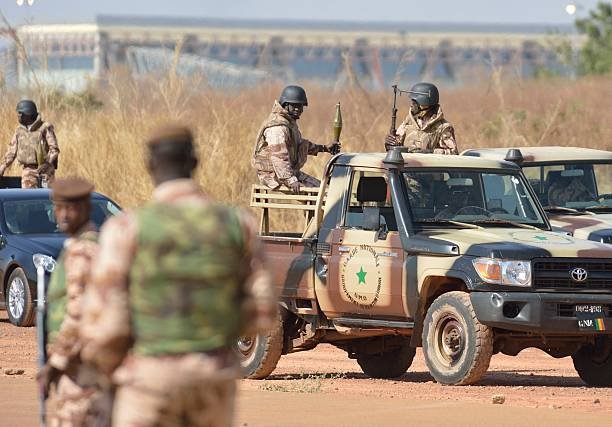
Mali’s armed forces and their Russian allies are facing renewed allegations of serious violations of international humanitarian law after a Human Rights Watch investigation documented attacks on civilians during counterinsurgency operations.
The report, published on Monday, 19 October 2026, described apparent indiscriminate drone strikes on a cattle market and a health facility, alongside other alleged abuses by government-aligned forces and insurgent groups.
According to Reuters, figures from the Armed Conflict Location & Event Data Project (ACLED) showed a sharp increase in drone strikes attributed to Malian forces and Russia’s Africa Corps.
The findings have renewed questions about civilian protection as Mali’s military-led government continues its campaign against Islamist insurgents and separatist fighters.
Drone strikes and civilian deaths more than double
ACLED recorded 47 drone strikes attributed to Malian forces and Africa Corps between April and August 2026, resulting in 94 reported civilian deaths.
During the corresponding five months of 2025, the organisation recorded 22 strikes and 44 civilian deaths.
The figures represent increases of approximately 114% in recorded strikes and 114% in reported civilian fatalities.
These are conflict-monitoring estimates and should not be confused with a complete list of incidents independently investigated by Human Rights Watch.
The increase came amid intensified fighting following coordinated insurgent attacks on 25 April.
Those attacks, attributed to the al-Qaeda-linked Jama’at Nusrat al-Islam wal-Muslimin (JNIM) and Tuareg-led separatists, targeted several locations, including military positions and Bamako’s main airport.
Mali’s defence minister was killed during the offensive.
The military authorities subsequently intensified operations with support from Africa Corps, a Russian-controlled paramilitary force that succeeded the Wagner Group’s role in Mali.

Cattle market strike leaves six civilians dead.
In its 19 October investigation, Human Rights Watch documented an apparent drone strike on a cattle market in Tombonkore village, in central Mali’s Bandiagara region, on 19 August.
The organisation reported that six civilian men were killed and at least 20 other people were injured.
Witnesses told researchers that a drone had flown over the area before releasing a munition into the market.
They said there were no JNIM fighters at the market or elsewhere in the village at the time.
Human Rights Watch reviewed witness accounts, photographs, and video evidence. It said the available evidence raised serious concerns that the strike was indiscriminate.
The organisation could not identify the specific drone or munition involved.
Its assessment of responsibility was based partly on the military capabilities of forces operating in the area.
Health facility damaged in northern Mali.
Human Rights Watch also investigated a pre-dawn drone strike on 29 July in Talahandak village, in the northern Kidal region near the Algerian border.
The attack reportedly partially destroyed a health facility.
The rights organisation examined video evidence and photographs of drone debris while investigating the incident.
It described the strike as apparently indiscriminate, raising concerns about whether the attacking forces had adequately distinguished military targets from civilian locations.
Under international humanitarian law, parties to a conflict must distinguish between civilians and combatants and take precautions to minimize civilian harm.
The presence of insurgents in a wider area does not, by itself, make every nearby civilian location a lawful military target.
Five girls killed in separate shootings
The investigation also documented alleged abuses unrelated to drone operations.
Human Rights Watch reported that Malian soldiers shot and killed five girls during a counterinsurgency operation in the Ségou region on 12 July.
According to the organisation, the soldiers mistook the girls for attackers.
The report also described the killing of three civilians by allied Dozo militia members in the Mopti region on 27 and 28 July.
These incidents were documented by Human Rights Watch but have not been established through court judgments.
The allegations add to concerns about the conduct of government-aligned forces and the protection of civilians in areas affected by insurgency.
Insurgent groups also accused of serious abuses
The investigation did not focus exclusively on the conduct of Mali’s military and its Russian partners.
Human Rights Watch also accused JNIM and allied separatist fighters of grave violations of the laws of war.
It reported that fighters attacked a Malian military convoy in the Gao region on 18 July and subsequently tortured and executed at least 19 captured soldiers.
JNIM’s Sharia Committee acknowledged that the executions occurred but denied that the group had ordered them.
The Azawad Liberation Front denied responsibility for executing the prisoners.
Captured soldiers are protected under international humanitarian law, and their execution is prohibited.
The allegations therefore concern serious abuses attributed to multiple parties in the conflict.
How Human Rights Watch investigated
Human Rights Watch said it interviewed 30 people remotely between 30 July and 20 September, including 16 witnesses to abuses, community leaders, journalists, human rights defenders, and a Malian soldier.
Its researchers also examined photographs and video material relating to reported attacks.
The organisation said it sent a letter outlining its findings and questions to Mali’s defence minister on 5 August but received no response.
Reuters separately reported that a Malian army spokesperson and the Russian embassy in Bamako did not respond to requests for comment.
Mali’s military authorities have previously denied allegations that their counterinsurgency operations deliberately targeted civilians.
The lack of responses to these particular requests does not establish an admission of responsibility.
Calls for African Union intervention
Human Rights Watch urged the African Union Peace and Security Council to give greater attention to civilian protection and accountability in Mali.
The organisation called for sustained scrutiny of abuses committed by government forces, their allies, and insurgent groups.
Its findings highlight the difficulty of protecting communities caught between military operations and attacks by armed organizations.
The immediate questions are whether the reported incidents will receive credible investigations, whether those responsible for unlawful acts will be held accountable, and what measures will be taken to reduce civilian casualties.
For communities affected by the fighting, the consequences are already severe. Markets, health facilities, and other places essential to everyday life have become part of the conflict’s human cost.