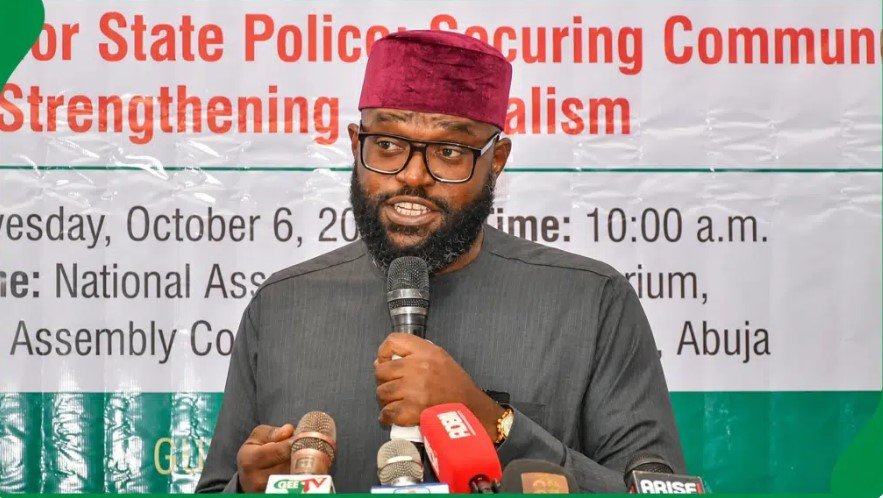
Edo, Rivers, Osun and Oyo have approved the constitutional amendment bill seeking to establish state police, according to Nnadubem Moghalu, President Bola Tinubu’s senior special assistant on planning and research.
Moghalu, who also serves as secretary of the presidential working group on the National Policing Bill, disclosed this at a parliamentary lecture in Abuja on Tuesday, 6 October.
TheCable reported his remarks on Wednesday. He said the four approvals represented the position when his lecture was prepared, rather than a completed nationwide approval process. thecable.ng, premiumtimesng.com
Twenty more state approvals needed
The proposed amendment requires approval by at least two-thirds of Nigeria’s 36 state Houses of Assembly, equivalent to 24 states.
The National Assembly’s explanation of the constitutional amendment process sets out that requirement.
Based on Moghalu’s count, another 20 state assemblies would need to approve the proposal to reach the state-level threshold. Four approvals alone do not establish state police or authorise the immediate creation of new forces. (nass.gov.ng)
Bill sent to states in September
The National Assembly transmitted the state police constitutional amendment to the 36 state legislatures on 16 September.
In a clarification reported by Voice of Nigeria, National Assembly Clerk Kamoru Ogunlana said this was the specific constitutional alteration bill sent to the states at that stage.
The legislature said it was incorrect to suggest that every constitutional amendment under consideration had been transmitted.
The proposal seeks to provide a constitutional basis for state police services alongside the existing federal policing system. (von.gov.ng)
Constitutional approval is only one stage.
Moghalu distinguished the constitutional amendment from the separate National Policing Bill being developed.
The amendment would provide the legal foundation for a dual policing system. The policing legislation would set out how that system should operate, followed by state legislation and the practical work of building institutions.
As Premium Times reported, Moghalu said changing the Constitution would not, by itself, recruit or train officers, establish stations or create investigative capacity.
Those tasks would require funding, preparation, and time. (premiumtimesng.com)
Political interference remains a concern.
Moghalu acknowledged the risk that governors could pressure state police to target political opponents, or that local majorities could use policing powers against minorities.
He argued that clear authority, accountability, and safeguards must be built into the system.
Former House minority leader Ndudi Elumelu also called for professional standards, adequate training, reliable funding, protection of human rights, and effective oversight.
These concerns remain part of the debate over how decentralised policing would work in practice. (thecable.ng, premiumtimesng.com)
Trivane View
Policing closer to communities could improve local knowledge and response times. But transferring power to states will only help if officers have the resources, training, and independence to serve the public fairly.
The final framework should make clear who appoints police leaders, who investigates misconduct, and how citizens can challenge abuse. Approval numbers matter, but the quality of those safeguards will determine whether the reform strengthens public safety.