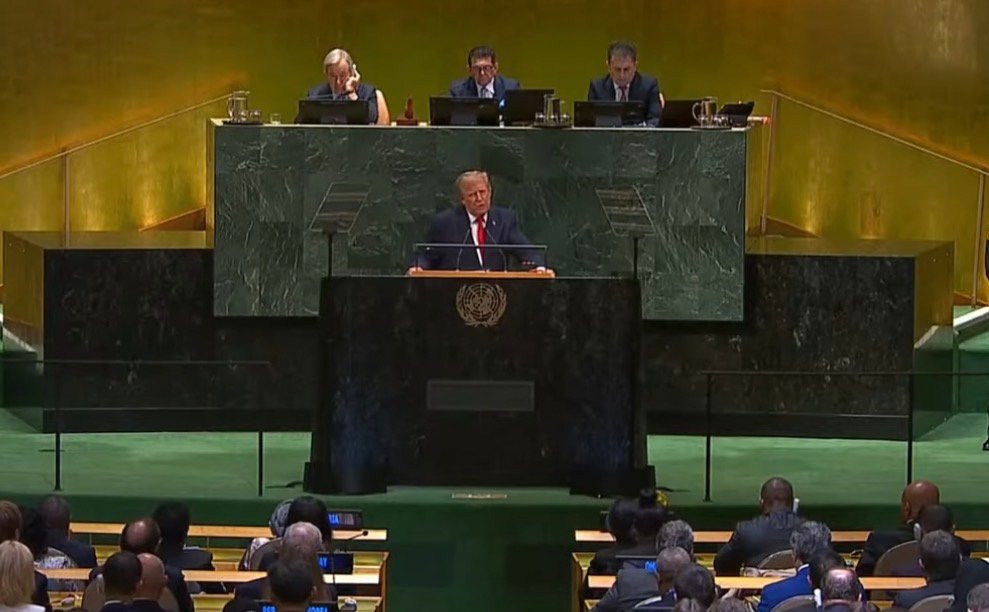
US President Donald Trump has defended his administration’s military campaign against Iran during an address to world leaders at the United Nations General Assembly in New York.
Trump used his speech on Tuesday to claim that the campaign had prevented Tehran from obtaining a nuclear weapon. He also presented his administration’s wider foreign policy as an effort to advance peace while protecting American interests.
According to Reuters, Trump also criticised the United Nations and other international institutions over what his administration considers interference with American sovereignty.
His address came as nearly 130 world leaders gathered for the 81st session of the General Assembly. The Iran conflict, Russia’s war in Ukraine and wider instability in the Middle East are among the leading issues before delegates.
Iran conflict dominates Trump’s message
The continuing US-Israeli war against Iran has disrupted energy markets, increased fuel prices and raised concerns about regional security and commercial shipping.
Trump claimed that military action had stopped Iran from obtaining a nuclear weapon. His statement reflects the position of his administration and has not been independently established as a final outcome of the campaign.
Iran has consistently rejected accusations that it intends to build a nuclear weapon, maintaining that its nuclear programme is for peaceful purposes.
The Iranian delegation walked out of the General Assembly hall during Trump’s speech, according to the Associated Press, as the US president defended his administration’s military action and renewed his criticism of Tehran.
Despite the continuing fighting, Washington and Tehran have recently indicated that further negotiations may be possible. No direct meeting between Trump and Iranian President Masoud Pezeshkian had been announced at the opening of the General Assembly.
Trump is also expected to meet leaders and representatives from Saudi Arabia, the United Arab Emirates, Qatar, Bahrain, Kuwait and Oman. Gulf countries are increasingly concerned about the conflict’s effect on regional security, oil supplies and shipping through the Strait of Hormuz.
Ukraine talks remain on the agenda
The war in Ukraine is also expected to feature prominently in Trump’s meetings in New York.
Before entering the UN gathering, Trump told reporters that his message to Russian President Vladimir Putin was to settle the conflict.
Trump is scheduled to hold talks with Ukrainian President Volodymyr Zelenskyy, who is seeking American support for an energy truce with Russia.
According to Reuters, the proposed arrangement would seek to stop attacks on energy infrastructure in both countries. Kyiv and Moscow have intensified strikes on each other’s energy facilities, raising concerns about further disruption as winter approaches.
Zelenskyy is also expected to raise Ukraine’s need for additional air defence systems, including Patriot missiles, as Russian drone and missile attacks continue.
Diplomatic meetings planned
Trump’s schedule includes meetings with British Prime Minister Andy Burnham, Venezuela’s interim leader Delcy Rodríguez, Danish Prime Minister Mette Frederiksen and Greenland’s Prime Minister Jens-Frederik Nielsen.
The United States, Denmark and Greenland are also expected to sign an agreement intended to expand the American military presence on the Arctic island and restrict access by rival powers.
The meetings reflect the broad diplomatic activity taking place around the General Assembly as governments seek progress on security, trade, energy and regional conflicts.
UN chief calls for cooperation
UN Secretary-General António Guterres opened the gathering by warning that divisions between countries were widening at a time of war, economic pressure, climate change and rapid developments in artificial intelligence.
In his final General Assembly address before leaving office at the end of 2026, Guterres called for stronger international cooperation and reforms to institutions struggling to respond to global crises.
He also warned against allowing powerful countries to act without effective international oversight and urged governments to pursue diplomatic solutions to armed conflicts.
The General Assembly’s general debate runs from 22 to 26 September and concludes on 28 September. Leaders are expected to address conflicts, economic pressures, climate change, artificial intelligence and questions about the future role of the United Nations.
This is a developing story.