
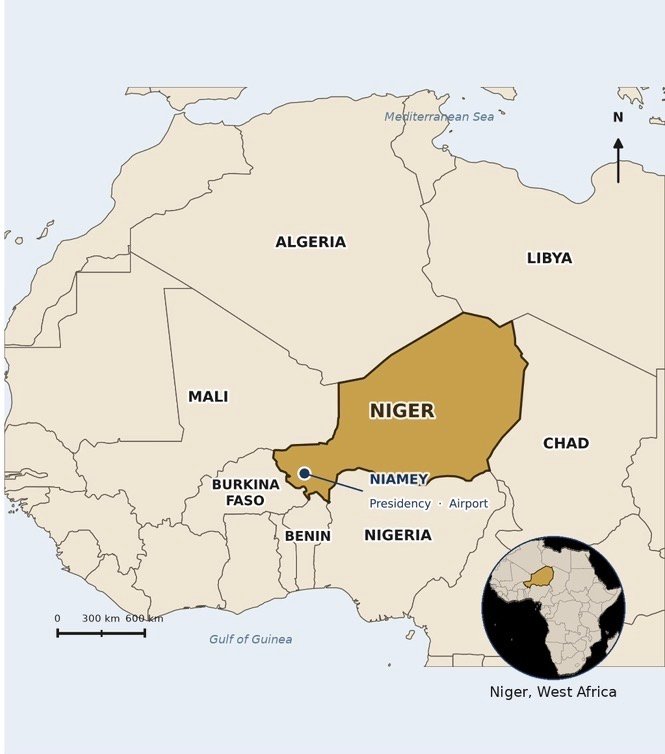
Mutinous soldiers attacked the presidential area and international airport in Niger’s capital, Niamey, early on Saturday, August 29, 2026, triggering hours of gunfire and explosions.
The attack involved members of Niger’s own armed forces and came at a difficult time for the military government, which is already struggling with attacks by armed groups across the country.
Reuters reported that the fighting began before dawn and affected several sensitive areas of Niamey. Niger’s Defence Ministry later said loyalist forces were gradually regaining control, although the situation around the airport remained uncertain for several hours.
What happened in Niamey?
Residents reported hearing heavy gunfire and explosions around the presidential area and Diori Hamani International Airport.
According to Reuters, some of the soldiers involved came from military units in Niamey as well as Ouallam, Tera and Dosso in southwestern Niger.
State television and radio were disrupted during the unrest. The government later returned to television with a statement from Defence Minister General Salifou Mody, who said the armed forces were progressively taking back control of the affected sites.
He urged people to remain calm and continue with their normal activities.
By later in the morning, Reuters reported that the presidential palace appeared to be under the control of loyalist troops. The situation around the airport was less clear, with security forces deployed to regain full control of the area.
The number of soldiers involved in the mutiny was not immediately known.
Who is behind the attack?
Reports from Reuters and other international news organisations described the attackers as mutinous soldiers rather than members of an outside armed group.
However, no recognised leader of the mutiny had been publicly identified at the time of publication. It was also unclear whether the soldiers were attempting to remove the government or were acting over grievances within the military.
That distinction matters. Niger has experienced repeated military takeovers, but an armed mutiny does not automatically mean another coup has succeeded.
Some of the soldiers involved reportedly came from areas where Niger’s military has suffered heavy losses while fighting armed groups linked to Islamic State.
Reuters cited security sources and analyst Yvan Guichaoua as saying frustration had been growing among some frontline troops over the worsening security situation.
Niger’s continuing security problem
Niger has been fighting armed groups linked to Islamic State and al-Qaeda for years, particularly near its borders with Mali and Burkina Faso.
The violence has continued despite the military government’s promise to improve security.
Niamey itself has not been untouched. Islamic State claimed responsibility for an attack on the city’s airport in January. Another attack on the airport and nearby military airbase in June killed members of the security forces and civilians, according to Nigerien authorities.
Saturday’s unrest is different because the attackers came from within the country’s military.
That raises questions not only about Niger’s ability to contain armed groups, but also about unity within its own security forces.
Why this matters for Niger
General Abdourahamane Tiani has ruled Niger since July 2023, when soldiers removed elected President Mohamed Bazoum from power.
Security was one of the reasons given for the takeover.
Since then, Niger has ended close military ties with France and other Western partners and strengthened relations with Russia. It has also joined Mali and Burkina Faso in the Alliance of Sahel States after the three countries withdrew from ECOWAS.
More than three years after Tiani took power, however, attacks by armed groups remain a serious problem.
An internal military revolt adds another layer of pressure. If dissatisfaction extends beyond the soldiers involved in Saturday’s attack, the government could face a challenge from within the same armed forces that brought it to power.
What remains unclear?
Several important details had not been confirmed when this article was prepared.
There was no reliable casualty figure, and the identities of those leading the mutiny remained unknown. It was also unclear how many soldiers had joined them.
There was no verified evidence that the government had fallen or that another military leadership had taken control of Niger.
Reuters reported that loyalist forces had secured the presidential palace, while efforts continued to restore control around the airport.
For now, describing the events as a military mutiny is more accurate than declaring another successful coup.
The coming hours will show whether the government can restore full control and, just as importantly, whether the unrest spreads to other military units.
Sources: Reuters; Niger Defence Ministry; France 24; NBC News; TimesLIVE.
Facts first. Not frenzy.