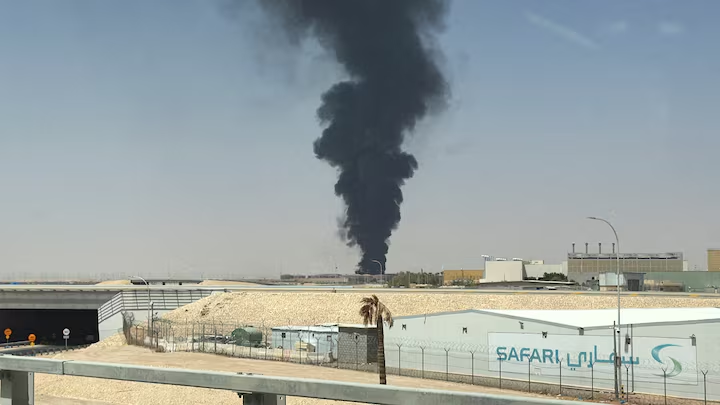
Air travel across Saudi Arabia has been severely disrupted by attacks attributed to Yemen’s Houthi movement, with cancellations affecting thousands of flights and forcing airlines to suspend services to the kingdom.
Data from the aviation analytics firm Cirium showed that 4,071 of the 4,736 flights scheduled at Riyadh’s King Khalid International Airport between October 8 and October 25 were cancelled, representing approximately 86 per cent of scheduled services.
The figures were reported by “Reuters on October 26″, as the Houthis continued to threaten Saudi airports, ports and oil infrastructure amid wider regional fighting.

Riyadh airport resumes limited operations
Saudi authorities partially reopened King Khalid International Airport on Sunday, October 25, after a suspension that began following an earlier attack this month.
Domestic flights resumed from Terminal 1, while Saudi national carriers were permitted to operate international services from Terminal 2.
The reopening did not immediately restore normal operations. International airlines continued to suspend services to Riyadh into November, while Delta Air Lines postponed its planned Riyadh route until next year.
The disruption has affected more than individual travellers. Reuters reported that cancellations forced events in the Saudi capital, including a major investment conference, to be cancelled or postponed as visitors struggled to reach the city.
Houthis claim fresh attacks
The Houthi movement said on Monday that it had attacked Riyadh’s airport again, describing the facility as a military target.
The group has also claimed attacks on Saudi oil infrastructure, including the kingdom’s East-West crude oil pumping stations. Saudi Arabia had not immediately confirmed the latest claims.
The Saudi-led coalition operating in Yemen said it had destroyed two ballistic missile launchers in the capital, Sanaa, including one it said had been used to fire a missile towards Riyadh that was intercepted.
The claims and counterclaims come amid a wider conflict involving Iran, Israel, and the United States, with Saudi Arabia increasingly exposed to attacks despite not being the principal combatant in that confrontation.
An attack on Riyadh airport on October 10 reportedly killed 13 people, making it the deadliest attack in Saudi Arabia in more than a decade, according to Reuters.
Disruption extends beyond the capital
The impact has spread across the Saudi aviation network.
Cirium data cited by Reuters showed that more than 7,800 flights, or 45 per cent of scheduled departures from Saudi airports, were cancelled between October 8 and October 25.
Other airports also experienced substantial disruption. Cancellations reached 42 per cent in Dammam and 46.7 per cent in Abha. At Najran airport, near the Yemeni border, all scheduled flights were cancelled during the period.
The figures show that the disruption is not limited to a single airport, affecting domestic travel and international connections across the country.
Wider economic and travel implications
Saudi Arabia is a major global oil exporter and a growing destination for business, tourism, and international events. Prolonged aviation disruption could complicate travel for investors, workers, visitors, and companies operating in the kingdom.
The cancellation figures also illustrate how security threats can affect economic activity even when airports begin to reopen. Airlines must assess the safety of routes, while passengers and businesses face uncertainty over schedules and connections.
However, flight cancellations alone do not establish the total economic cost of the disruption. That would require further data on lost revenue, travel spending, airline losses, and delayed business activity.
What happens next?
Saudi Arabia’s ability to restore normal air travel will depend on the security situation, airline decisions, and whether further attacks occur.
The partial reopening of Riyadh airport is a step towards resuming services, but the scale of cancellations recorded through October 25 indicates that aviation operations remain under significant pressure.