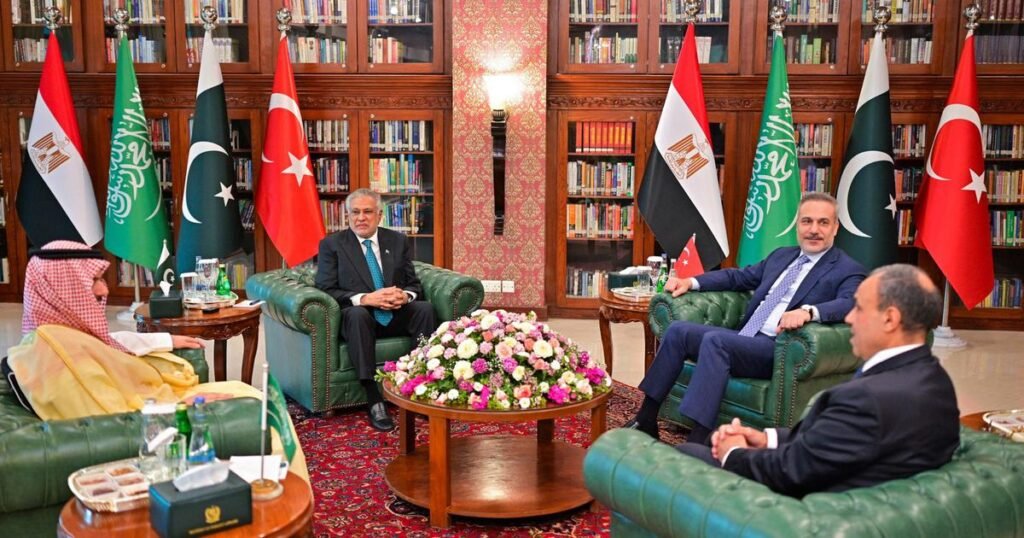
Senior officials from Saudi Arabia, Pakistan, and Türkiye met Iranian authorities in Tehran on Monday, October 26, in an effort to reduce regional tensions and avert renewed escalation involving Iran, Israel, and the United States.
The talks bring together countries with significant strategic interests in the Middle East at a time when threats of further military action, attacks involving Yemen’s Houthi rebels, and stalled negotiations between Washington and Tehran are adding to uncertainty.
The “Associated Press reported” that the delegations were seeking ways to prevent another phase of fighting and support efforts to reach an agreement between Iran and the United States.
Who is taking part?
The delegations include Saudi Defence Minister Prince Khalid bin Salman, Pakistan’s army chief, Field Marshal Asim Munir, and Türkiye’s intelligence chief, Ibrahim Kalin.
They were expected to meet Iranian security officials and negotiators to discuss regional security and diplomatic options.
Saudi Arabia said the delegations hoped to find ways to de-escalate tensions and promote regional stability. Iran’s Foreign Ministry spokesperson, Esmail Baghaei, said the discussions would address pressing security threats, although he noted that the meeting’s agenda had not been fully set.
The talks also come within the context of the Mecca Joint Defence Agreement involving Saudi Arabia, Pakistan, and Türkiye, signed in August. The agreement provides a framework for cooperation among the three countries, although Türkiye’s ratification process was still under way, according to a Reuters’ report on the meeting”

Diplomacy faces major obstacles
The meeting follows earlier mediation efforts involving Pakistan and Qatar, which helped broker an interim agreement in June intended to reopen the Strait of Hormuz to shipping, end a United States blockade of Iranian ports, and begin broader negotiations over Iran’s nuclear programme.
That arrangement subsequently unravelled as attacks resumed, leaving key disagreements unresolved.
Iran has said it remains open to diplomacy but has rejected US demands it describes as requiring complete surrender. Meanwhile, Israeli Prime Minister Benjamin Netanyahu has warned that Iran or groups aligned with it could launch attacks ahead of Israel’s election.
These competing positions underline the difficulty of reaching a lasting agreement, even as regional powers seek to prevent the conflict from widening.
Yemen adds another layer of risk
The war in Yemen is also contributing to the regional security crisis. Houthi rebels have increasingly targeted Saudi-backed forces, while the Saudi-led coalition has carried out strikes in Houthi-controlled areas.
The AP reported that Houthi military spokesperson Yahya Saree claimed the group had launched missile attacks against Saudi-backed forces in Yemen on Monday. The news agency said it could not independently verify the claims.
The expanding confrontation increases the risks facing neighbouring countries and adds pressure to the diplomatic efforts in Tehran.
What the talks could mean
The meeting offers a channel for regional powers to discuss security concerns directly with Iran, but it does not by itself establish that a ceasefire or broader agreement has been reached.
The central challenges remain the breakdown of previous arrangements, disputes between Tehran and Washington, and the threat of further military action by the parties involved.
Whether the discussions lead to concrete steps will depend on the willingness of the countries involved to move beyond statements of intent and agree on measures that can be implemented and sustained.