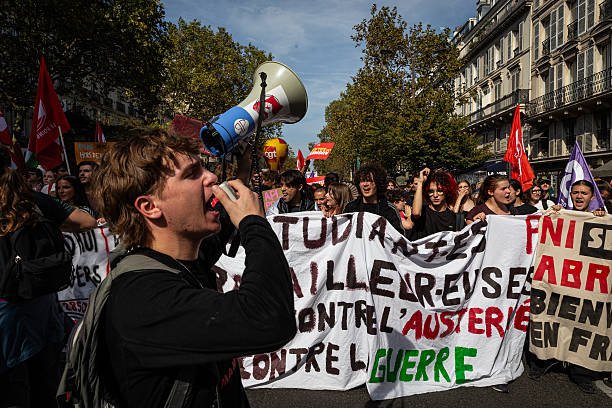
Thousands of people demonstrated in France, Belgium, Italy, and Portugal over the weekend of 17 October 2026, protesting against rising living costs, housing pressures, and problems affecting public services.
The demonstrations were organized separately and reflected different national concerns. While many remained peaceful, clashes with police and incidents of vandalism were reported in several cities.
According to Al Jazeera’s report published on 17 October, the protests brought together grievances over wages, education, housing and the cost of everyday essentials.
The unrest comes as European households continue to face the accumulated effects of several years of price increases, even where annual inflation has slowed.
France sees widespread demonstrations
France experienced some of the largest protests, following weeks of demonstrations by students concerned about education conditions.
The movement expanded to include wider complaints about living costs, wages, and public services.
The French Interior Ministry estimated that more than 550,000 people joined demonstrations on Saturday, according to Al Jazeera.
Although many marched peacefully, violent groups clashed with police, looted shops, and damaged public buildings in several cities.
President Emmanuel Macron condemned the violence and called for those responsible to face prosecution.
The unrest also created political pressure on the government over its handling of security and the concerns raised by demonstrators.
Belgian students protest education costs
In Belgium, demonstrations centered on education reforms and the increasing financial burden facing students.
Protesters gathered in Brussels and Liège, where police used water cannon to disperse crowds following confrontations.
Student groups have expressed concern about university registration fees, access to education, and the cost of study materials.
The demonstrations reflected frustration over the affordability of higher education and the financial difficulties faced by young people.
Italy faces clashes during demonstrations.
In Italy, protests in Milan and Bologna brought together concerns about living costs, government policies, and international conflicts.
A demonstration in Milan began peacefully before masked protesters clashed with police, threw objects, and damaged property.
Police used tear gas and water cannon to disperse crowds.
Italian Prime Minister Giorgia Meloni condemned the violence, while Milan’s mayor acknowledged the concerns behind the demonstrations but rejected attacks on public property and security personnel.
The incidents illustrated the distinction between peaceful protest and criminal violence occurring alongside some demonstrations.
Portugal’s housing crisis takes centre stage
In Portugal, tens of thousands of demonstrators marched in Lisbon over housing affordability, low wages, and the rising cost of living.
Protesters called for higher pay and pensions, as well as measures to make housing more accessible.
Housing has become a major source of pressure, particularly for younger workers and families living in major cities.
Al Jazeera reported that house prices in Portugal had more than doubled since 2017, while rents for new leases had also risen sharply.
Higher housing costs leave households with less money for food, transport, and other essential expenses.
They can also make it difficult for workers to live near employment opportunities.

Why households still feel the pressure
Recent economic figures help explain why many families remain concerned about affordability.
According to a Euronews analysis published on 27 September, food and non-alcoholic beverage prices across the European Union increased by approximately 34% between August 2021 and August 2026.
The analysis used Eurostat data to compare price changes across European countries.
The increase represents the accumulated rise over five years, not the inflation rate for a single year.
It is also important to distinguish slowing inflation from falling prices.
When inflation declines, prices may still be rising, but at a slower pace. Families therefore continue paying more than they did several years earlier unless prices actually fall.
Have wages kept pace with prices?
The Euronews analysis also compared changes in statutory minimum wages with food prices.
The findings showed considerable differences between countries.
Some minimum wages increased faster than food prices, while workers in other countries experienced weaker purchasing power when measured against the cost of groceries.
However, the comparison does not capture every household’s financial circumstances.
Gross minimum wages do not show the amount workers take home after deductions, while rent, energy, transport, and childcare can account for substantial shares of household spending.
Families on lower incomes may be particularly exposed because essential expenses often take up a greater proportion of their budgets.
Governments face pressure for solutions
The demonstrations have increased demands for government action, although the priorities differ across countries.
In France and Belgium, education funding and access to public services have featured prominently.
In Portugal, housing affordability and wages remain central concerns.
Italian demonstrations have included objections to living and wider government policies.
The responses available to governments also differ because of national budgets, housing markets, and economic conditions.
Reducing inflation can help limit further price increases, but it does not automatically restore the purchasing power lost during earlier periods of rapid inflation.
What happens next?
The protests show that economic frustration in Europe extends beyond headline inflation figures.
Housing costs, education expenses, wages, and access to public services all influence whether people feel financially secure.
The demonstrations were not one coordinated European movement, but they revealed concerns shared by households in several countries.
Whether further protests occur will depend on national developments and how governments respond to demands for affordable housing, better services, and improved living standards.
For policymakers, the challenge is not simply to slow price increases, but to address the financial pressures that continue to shape everyday life.