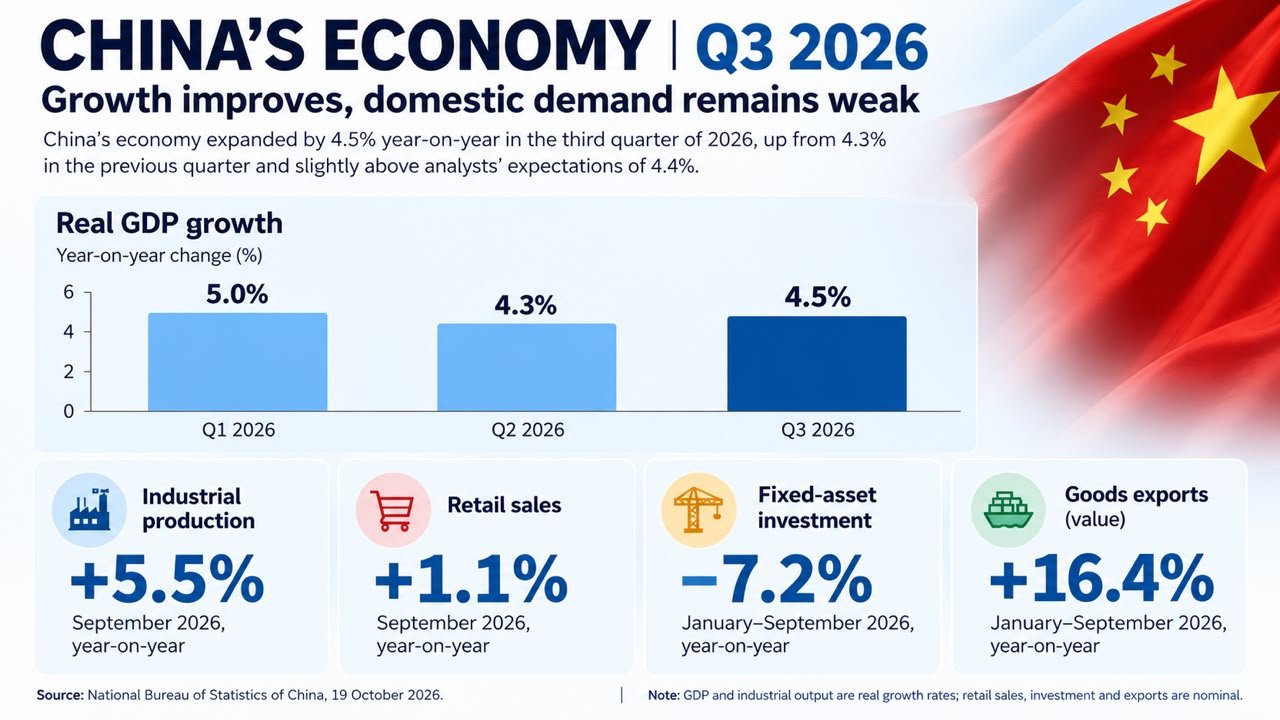
China’s economy grew by 4.5% in the third quarter of 2026 compared with the same period last year, exceeding economists expectations as strong exports and industrial production helped offset weak domestic demand.
Figures released by China’s National Bureau of Statistics on Monday, 19 October showed that growth accelerated from 4.3% in the second quarter.
The result also exceeded the 4.4% increase forecast in a Reuters survey of economists.
On a quarter-on-quarter basis, gross domestic product (GDP) rose by 1.2%, compared with 0.9% in the previous quarter.
The improvement provides some relief for policymakers seeking to achieve China’s annual growth target of 4.5% to 5%, but the figures also reveal continuing weaknesses in household spending and investment.
Exports and manufacturing support growth
China’s industrial sector remained a major source of economic strength during the quarter.
Industrial production rose by 5.5% year-on-year in September, up from 5.2% in August.
High-technology manufacturing was particularly strong. Official figures showed that output in this sector increased by 14.3% during the first nine months of the year, while equipment manufacturing expanded by 10.2%.
Exports also continued to support economic activity.
According to the Associated Press, demand for Chinese manufactured goods, including technology-related products, has helped sustain growth despite subdued spending at home.
Official data showed that the value of China’s goods exports rose by 16.4% in the first nine months of 2026 compared with the same period last year.
Strong overseas sales have supported factories and employment in export-oriented industries, although they have also contributed to trade tensions with major economic partners.
The figures underline China’s continued reliance on manufacturing and external markets to support expansion.

Consumer spending remains subdued.
Domestic demand has not strengthened at the same pace as industrial production.
Retail sales rose by 1.1% year-on-year in September. Although this represented an improvement from August, it remained modest compared with the growth recorded in manufacturing.
Consumer spending has been constrained by concerns about employment, household finances, and the prolonged downturn in the property market.
When households are uncertain about future income or the value of their homes, they may choose to save rather than increase spending.
That can make it harder for businesses serving the domestic market to expand.
Stronger consumer demand would help China achieve more balanced growth by reducing its dependence on exports and industrial investment.
Investment and property sector remain under pressure.
The latest official figures also showed a continued decline in investment.
Fixed-asset investment fell by 7.2% during the first nine months of 2026 compared with the same period last year.
This measure includes spending on areas such as buildings, infrastructure, and machinery.
The property sector remains a major source of weakness after several years of falling home sales, financial pressure on developers, and declining confidence among buyers.
Problems in the housing market can affect construction companies, suppliers, local government finances, and households whose wealth is tied to property.
The combination of weak investment and cautious consumer spending suggests that the recovery has not yet become broad-based.
Government faces difficult policy choices.
China’s government has set a growth target of approximately 4.5% to 5% for 2026.
The economy expanded by 4.6% during the first nine months, placing growth within that target range so far.
However, meeting the full-year goal will depend on economic performance during the final quarter.
As Reuters reported, the stronger GDP result may reduce immediate pressure for more aggressive economic stimulus.
Authorities have already introduced measures intended to support home buyers and direct financing towards infrastructure and technology.
Further intervention could support domestic activity, but policymakers must also consider financial risks and the effectiveness of additional spending.
External conditions remain uncertain. Changes in demand for technology products, new trade restrictions, or slower growth in overseas markets could affect China’s export performance.
Outlook depends on domestic recovery.
The third-quarter figures show that China’s economy has regained some momentum, supported by strong manufacturing and exports.
Yet the gap between industrial performance and domestic spending remains substantial.
The next important indicators will include retail sales, private investment, housing activity, and export demand during the final months of 2026.
Sustained growth will depend not only on continued demand for Chinese goods overseas but also on whether households and businesses regain enough confidence to increase spending and investment at home.