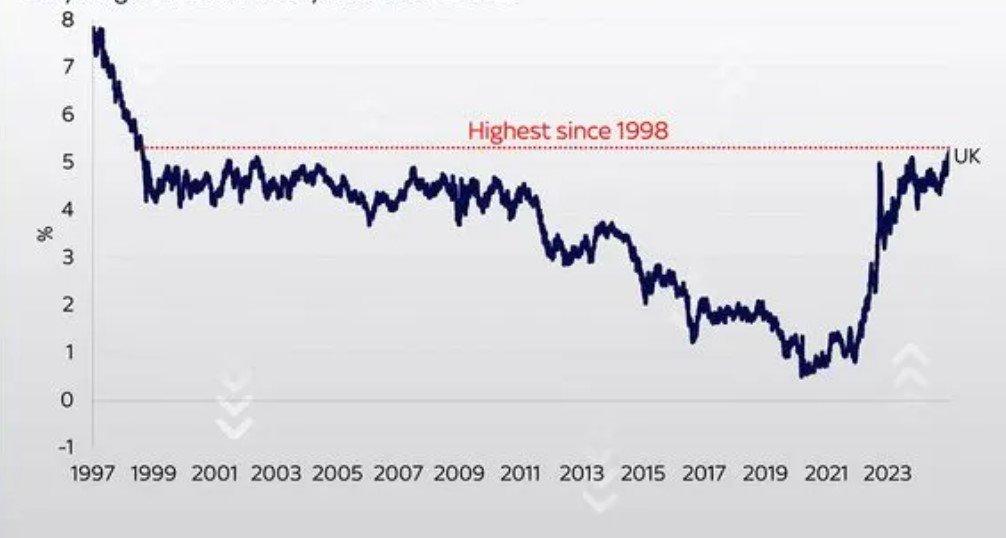
The UK’s benchmark 10-year government bond yield touched 5.527% on Thursday, 8 October, its highest level since July 2007, according to Reuters.
Yields on 20-year and 30-year government bonds reached 6.00% and 6.05% respectively, their highest levels since early 1998. The increases formed part of a wider international sell-off in government debt. (reuters.com)
The figures were Thursday’s trading peaks. On Friday, 9 October, Reuters reported that oil prices had fallen and global bond yields had eased from their recent highs. (reuters.com)
Why oil prices matter
Brent crude rose above $105 a barrel on Thursday amid attacks on shipping in the Gulf and concerns that a hurricane could disrupt US oil production.
Higher energy costs can increase household bills and businesses’ operating expenses. If companies pass those costs to customers, inflation can rise, complicating decisions about interest rates. (theguardian.com, bankofengland.co.uk)
In a speech on Thursday, Bank of England governor Andrew Bailey warned that repeated supply disruptions could weaken economic activity while pushing prices higher. He said central banks must assess whether temporary price increases are becoming more persistent. (bankofengland.co.uk)
Pressure on public finances
UK government bonds are known as gilts. Their yields reflect the return available to investors at current market prices. When bond prices fall, yields rise.
Persistently higher yields increase the cost of issuing new debt and replacing borrowing that reaches maturity. Existing conventional gilts continue to pay their agreed fixed interest payments. (dmo.gov.uk, dmo.gov.uk, obr.uk)
Bailey said higher borrowing costs and weaker growth put additional pressure on government finances. He stressed the importance of credible policies for managing public debt. (bankofengland.co.uk)
What households should know
Gilt yields are separate from the Bank of England’s policy rate. The Bank held its official rate at 3.75% in its September decision.
Market interest rates also influence the pricing of new fixed mortgage deals. Changes can therefore matter to homebuyers and borrowers approaching refinancing, although lenders’ pricing and individual circumstances vary.
An existing fixed mortgage rate normally remains unchanged until its agreed term ends. Thursday’s bond-market movement does not automatically increase every borrower’s monthly payment. (bankofengland.co.uk, bankofengland.co.uk, bankofengland.co.uk)
What comes next
Chancellor John Healey is due to deliver the Budget on 28 October. The Bank of England’s next scheduled interest-rate decision is on 5 November.
Both will be closely watched for their assessment of inflation, growth, and the pressure on borrowing costs. (gov.uk, bankofengland.co.uk)