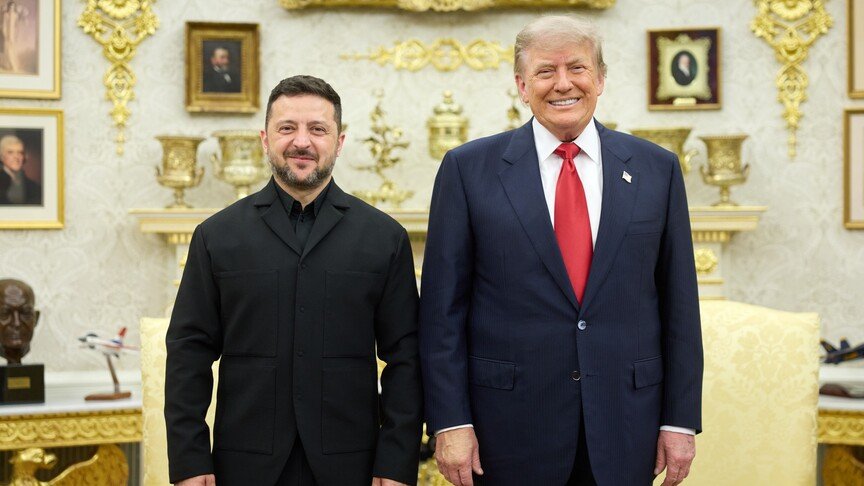
US President Donald Trump has urged Ukrainian President Volodymyr Zelenskyy to stop attacking Russian diesel facilities, claiming that the strikes are contributing to a global shortage of the fuel.
Trump made the remarks on Sunday, September 13, while speaking to reporters during a visit to his golf resort in Doonbeg, Ireland.
He said Zelenskyy should direct Ukrainian forces towards other targets and avoid facilities involved in producing diesel.
“Mr Zelensky has to do one thing. He has to stop knocking out diesel fuel in Russia,” Trump said, according to Reuters.
Trump also said the United States had raised the issue directly with the Ukrainian leader. Kyiv had not issued an immediate public response to the president’s remarks at the time of publication.
Kremlin welcomes Trump’s intervention
The Kremlin welcomed Trump’s comments on Monday, September 14.
Kremlin spokesman Dmitry Peskov said Moscow supported calls for attacks on what Russia describes as civilian economic infrastructure to end.
Russia has repeatedly condemned Ukrainian strikes on refineries and other energy facilities. However, Moscow continues to carry out missile and drone attacks against Ukrainian infrastructure, including power systems, transport facilities and fuel sites.
According to a second Reuters report, Peskov said disruption in global energy markets was also connected to instability in the Persian Gulf.
Russia has restricted diesel exports as it attempts to protect supplies for its domestic market following repeated attacks on its refining network.
Ukraine targets Russian energy sector
Ukraine has intensified long-range drone attacks against Russian oil refineries and fuel facilities in recent months.
Kyiv argues that Russia’s energy industry is a legitimate military target because it generates revenue for the Kremlin and supplies fuel used by Russian forces.
The attacks have damaged production units at several refineries, reduced Russia’s fuel output and contributed to shortages in parts of the country.
Ukraine has described its campaign against Russian energy and military sites as a form of “long-range sanctions” intended to increase the economic cost of Moscow’s invasion.
An assessment published by the Institute for the Study of War said Ukrainian strikes had damaged important processing units at Russia’s Kirishi refinery. Ukraine has also reported attacks on military logistics, ammunition depots and energy facilities in Russian-controlled territory.
The strikes form part of Kyiv’s wider attempt to weaken Russia’s ability to finance and sustain the war.
Several factors affecting diesel prices
Trump attributed the diesel shortage mainly to Ukrainian attacks on Russian facilities. However, international fuel markets are also being affected by disruption in the Middle East and restrictions on major shipping and energy routes.
The Associated Press reported that diesel prices in the United States had risen above $6 per gallon on average.
Russia’s restrictions on diesel exports have added pressure to international supplies. At the same time, disruption linked to the conflict involving Iran has affected oil movements through the Strait of Hormuz, one of the world’s most important energy routes.
Reduced refinery output, transport disruption and uncertainty about future supply have combined to push energy prices higher.
Diesel is widely used in freight transport, agriculture, construction and manufacturing. A sustained increase in its price can raise the cost of moving goods and place further pressure on household and business expenses.
Request comes amid continuing Russian attacks
Trump’s intervention came as Russia continued a large-scale campaign of missile and drone attacks against Ukraine.
On September 13, Russian strikes hit areas close to Ukraine’s border with Poland. A locomotive on a passenger train was damaged near the border, while another strike reportedly hit a petrol station.
Ukraine’s Foreign Minister Andrii Sybiha described the attacks as a warning to European Union and NATO countries.
The continuing strikes highlight the difficult position surrounding Trump’s request. Washington is asking Kyiv to avoid parts of Russia’s fuel industry while Russian forces continue targeting Ukrainian infrastructure.
Trump said Ukraine could select other targets, but he did not explain whether the United States would introduce any formal restrictions on military assistance or intelligence if Kyiv continued attacking Russian refineries.
His comments may increase pressure on Ukraine as Washington continues efforts to negotiate an end to the war.
For now, Ukraine’s attacks on Russia’s energy sector remain an important part of its military strategy, while concerns about global fuel supplies are becoming another source of tension between Kyiv and the Trump administration.