
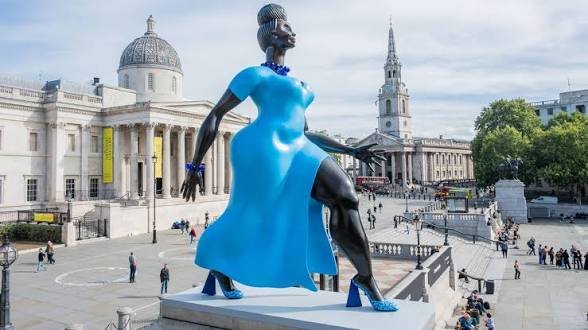
A towering bronze sculpture of a Black woman dressed in vivid blue has been unveiled on the Fourth Plinth in London’s Trafalgar Square, placing an everyday contemporary figure at the centre of one of Britain’s best-known public spaces.
Lady in Blue, created by New York-based artist Tschabalala Self, was unveiled on 10 September 2026. According to London City Hall, it is the 16th artwork commissioned for the plinth since the public art programme began in 1998.
The sculpture shows a woman moving forward in a bright blue dress and high heels, with matching blue jewellery. Her confident stride and commanding scale give her a strong presence among Trafalgar Square’s historic monuments.
A modern woman in a historic setting
City Hall describes the figure as a young metropolitan woman and a contemporary “everywoman”. Rather than portraying a monarch, military commander or political leader, the work celebrates a person who could be encountered on the streets of London today.
That contrast is central to the sculpture’s meaning. The figure stands in a square associated with British history and imperial power, but represents modern urban life and the people who shape it through their everyday presence.
Self has said the work pays tribute to contemporary women and reflects the shared experience of city life. The sculpture also continues her wider artistic interest in the Black female body, identity and the ways women occupy public space.
Although Self was born in Harlem, New York, she has an established connection with London. City Hall said the capital hosted her first institutional exhibition and the creation of her first major body of paintings.
A traditional material with a bold finish
Lady in Blue is made from bronze, linking it to the material traditionally used for monuments and public statues. Its colour, posture and styling, however, give it a distinctly contemporary character.
The bronze surface carries a striking blue finish inspired by lapis lazuli. City Hall notes that the colour has a long artistic history across North Africa, the Middle East and Europe. It gives the sculpture an immediate visual identity while connecting the new work to centuries of art and pigment-making.
Photographs published through Reuters show Self standing beside the completed sculpture following its unveiling. The images highlight the figure’s scale, the flowing shape of the dress and the contrast between the bright blue surface and the stone architecture surrounding Trafalgar Square.
Chosen with public involvement
Self’s proposal was selected in 2024 after the public was invited to comment on shortlisted designs. More than 10,000 comments were submitted, helping to inform the final decision made by the Fourth Plinth Commissioning Group.
The programme is funded by the Mayor of London, with support from Arts Council England and Bloomberg Philanthropies. It has become one of the world’s most recognised programmes for temporary public art, giving artists an opportunity to respond to the meaning of monuments and public space.
Previous Fourth Plinth works have included a giant blue cockerel, a bronze thumbs-up and Samson Kambalu’s Antelope, which reimagined a 1914 photograph of Baptist preacher and anti-colonial figure John Chilembwe.
Lady in Blue replaces Teresa Margolles’s Mil Veces un Instante, also known as A Thousand Times in an Instant. That installation featured hundreds of plaster casts of faces from transgender, non-binary and gender-nonconforming communities in Britain and Mexico.
What happens next
Lady in Blue is expected to remain on the Fourth Plinth until 2028. The Art Newspaper reports that the sculpture is then due to move to a private foundation in Fornebu, Norway, where it will remain publicly accessible.
Its planned successor is Untitled by Romanian artist Andra Ursuţa. The work will present a shrouded horse and rider cast in translucent green resin, continuing the programme’s examination of power, memory and the tradition of public monuments.
The unveiling also comes shortly before London Sculpture Week, scheduled for 19 to 27 September 2026, when exhibitions, tours and events will celebrate sculpture across the capital.
For millions of residents and visitors who pass through Trafalgar Square, Lady in Blue offers a different kind of monument. It does not honour inherited rank or military victory. Instead, it gives scale, visibility and permanence to an ordinary woman moving confidently through the modern city.