
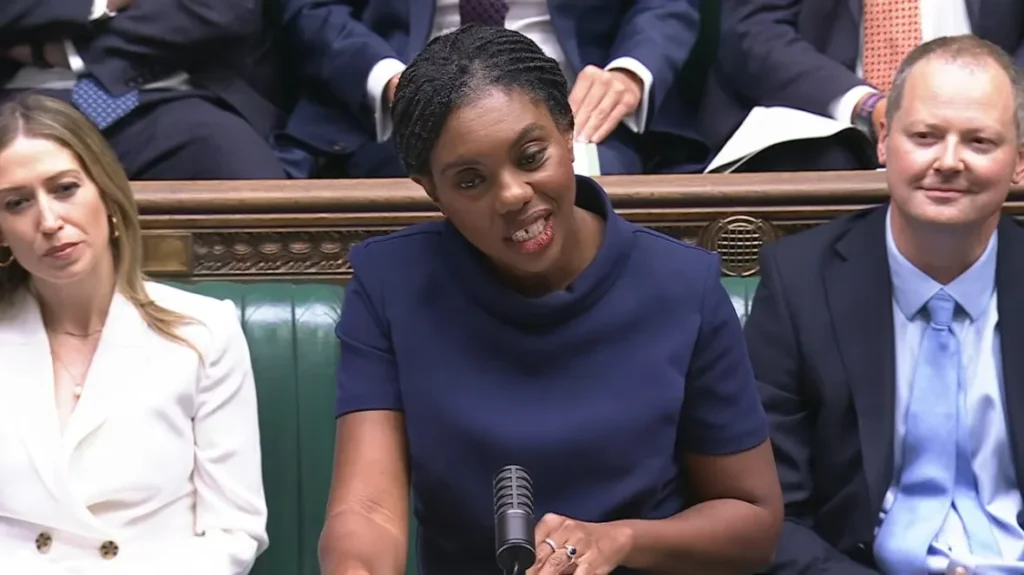
Conservative leader Kemi Badenoch has challenged Prime Minister Andy Burnham over how his government intends to pay for increased UK defence spending, bringing national security and the state of Britain’s public finances into the centre of their first clashes in Parliament.
The exchange came during Burnham’s first Prime Minister’s Questions since entering Downing Street.
Badenoch pressed the Prime Minister over his spending commitments and repeatedly questioned whether his government would cut welfare spending or increase taxes to meet its priorities.
Burnham declined to set out specific tax decisions ahead of the government’s Budget, telling MPs that he would not announce the Budget from the despatch box.
Defence spending becomes political dividing line
The debate comes as the UK faces pressure to increase investment in its armed forces amid heightened security concerns in Europe and continuing Russian aggression.
Burnham has reaffirmed the government’s commitment to increase defence spending to 3.5% of GDP by 2035.
However, questions remain over how Britain will finance the increase while maintaining other public spending commitments and operating within the government’s fiscal rules.
The issue predates Burnham’s premiership. A Defence Investment Plan published under his predecessor, Keir Starmer, included billions of pounds in additional military investment but attracted criticism over how some of the spending would ultimately be financed.
Conservatives propose welfare cuts
Badenoch is seeking to draw a clearer distinction between the Conservative and Labour approaches.
The Conservative leader has pledged to increase defence spending to 3% of GDP by 2030, with reductions in welfare spending forming part of the funding plan.
Her proposals would redirect billions of pounds towards defence, although the Conservatives have also faced questions over how they would finance further increases beyond that level.
In July, Badenoch acknowledged that her party had not yet identified all the money required to reach defence spending of 3.5% of GDP.
The disagreement therefore extends beyond whether Britain should spend more on defence. Both major parties accept the need for higher military investment. The more difficult political question is where the additional money should come from.
Burnham resists pressure over taxes
Badenoch also pressed Burnham over whether higher taxes could be used to finance his government’s spending commitments.
The Prime Minister did not rule out future tax changes, saying decisions would be set out through the normal Budget process.
That leaves his government facing competing pressures.
Higher defence spending requires substantial additional resources at a time when ministers must also consider demands on healthcare, welfare, infrastructure and other public services.
The Resolution Foundation has estimated that reaching defence expenditure of 3.5% of GDP by 2035 could require around £28 billion in additional annual spending.
Security concerns add urgency
The political argument is taking place against a more difficult European security environment.
Russia’s war against Ukraine and wider concerns about Moscow’s activities in Europe have increased pressure on NATO members to strengthen military capabilities.
During the parliamentary exchanges, Burnham reiterated Britain’s support for Ukraine and defended his government’s commitment to defence.
The challenge for his administration is now to demonstrate how those commitments can be financed without creating unsustainable pressure elsewhere in the public finances.
Trivane View: The argument is increasingly about who pays
The disagreement between Badenoch and Burnham reveals an important shift in Britain’s defence debate.
The main political parties are no longer arguing simply about whether defence spending should increase. The increasingly difficult question is who ultimately pays for it.
Welfare reductions, higher taxation, additional borrowing or cuts elsewhere in government spending each carry consequences for households and public services.
For Burnham, promising stronger defence investment is only the first part of the challenge. His government will eventually have to show how its security commitments fit alongside its economic and domestic priorities.
For Badenoch, proposing welfare reductions provides a clearer funding choice, but the Conservatives will also face scrutiny over whether those reductions can deliver enough money to meet Britain’s longer-term defence commitments.
As defence spending rises, the debate over Britain’s security is therefore becoming inseparable from a wider argument about the country’s economic priorities.
Source: The Independent, 2 September 2026.
Facts first. Not frenzy.